
Protecting the area around a pond or, more broadly, securing outdoor areas is an obvious way to avoid accidents in the home, particularly those involving children and pets. Nowadays, what effective solution can be adopted to greatly limit the risks in this area? Here’s what you need to know to choose and install the right safety net for your pool or terrace, a solution that’s both discreet and reliable.
 A significant risk of accidents outdoors
 A significant risk of accidents outdoors
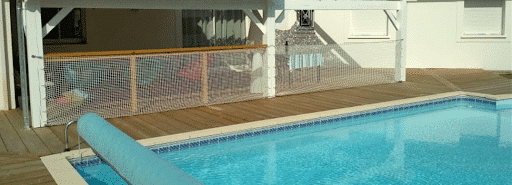
Every year, a large number of domestic accidents occur outdoors, particularly around swimming pools, terraces, balconies or staircases, and young children and pets are often the first victims. In environments with little or no safety, certain frequent situations can quickly turn into accidents, including :
- a slide by the pool;
- a child climbing a low wall or railing;
- an animal passing through a guardrail spaced too far apart;
- a fall from an unprotected terrace;
- unintentional access to an unsupervised swimming pool.
Although preventable, some are unfortunately and all too often the cause of the 20,000 or so deaths caused by domestic accidents in France.
In the face of these everyday risks, safety nets represent an affordable investment, but one that could not be more decisive in preventing tragedies. These passive protection tools can effectively prevent falls without detracting from the aesthetics of the site, whether it’s a home or a public space.
 Standards to comply with
 Standards to comply with
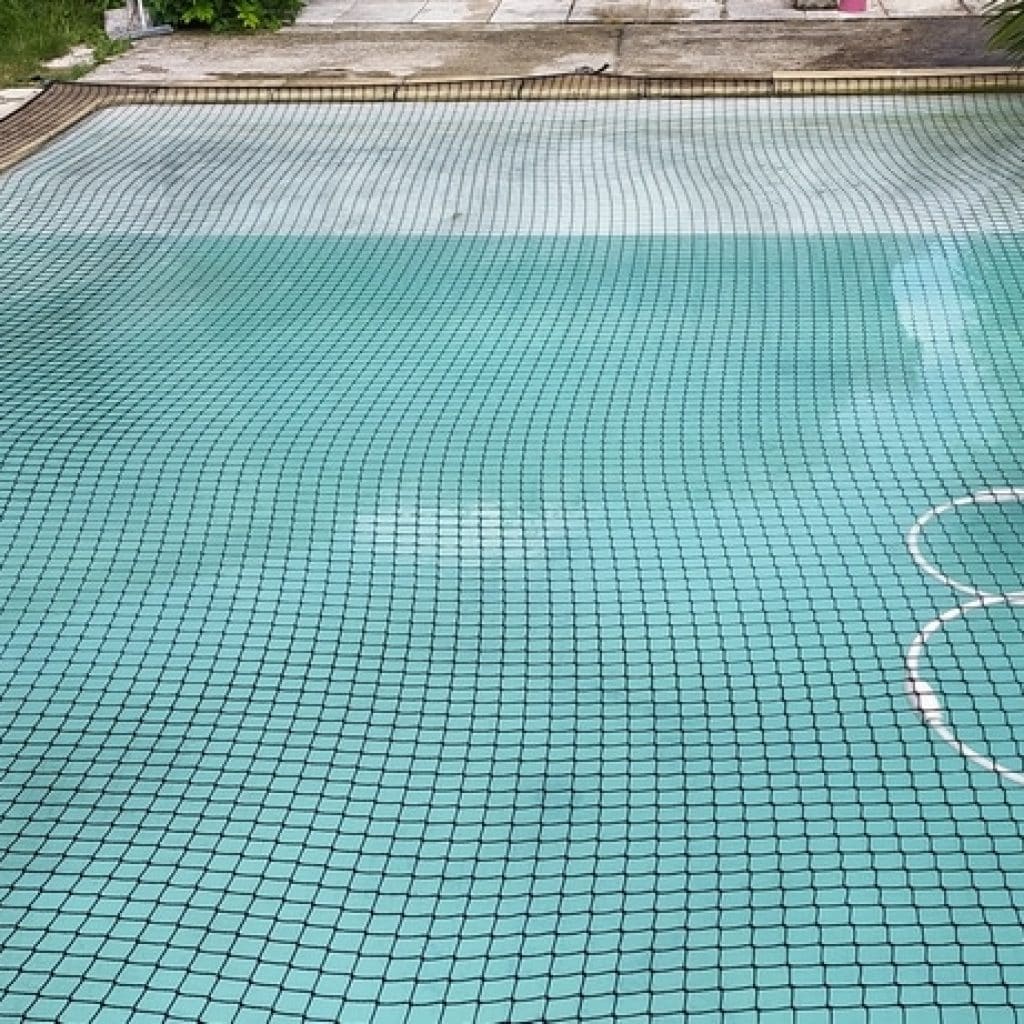
French law requires owners of private in-ground or semi-in-ground pools to install a compliant safety device to prevent the risk of drowning, particularly among young children. Several safety net standards will be in force in 2025. Firstly, the NF P90-306 standard governs protective barriers: they must be at least 1.10 meters high, impassable by children under 5 years of age, and have no elements facilitating climbing. They must also be equipped with a secure locking system and withstand shocks equivalent to a weight of 50 kg. Then there is standard NF P90-308, which applies to tarpaulins, covers and occlusion devices, which must be designed to prevent involuntary immersion, resist climbing and not cause injury in the event of a fall.
For terraces, the Afnor standard NF P 01-012 defines the requirements for guardrails when the fall height exceeds 1 meter. This equipment must have a minimum height of one meter, resist a horizontal pressure of 60 daN/m, and prevent a child from passing through gaps greater than 11 cm. In this regulatory context, the safety net is undoubtedly a relevant solution, both to protect access to a swimming pool and to secure a terrace, provided it meets the technical requirements for resistance and installation.
Characteristics of a suitable net
The right safety net meets a number of very important criteria, ensuring both its effectiveness and its integration into the environment.
- It’s made from reliable materials (polyamide, polyester, dyneema, polyethylene, among others), depending on the intended use.
- This terrace or pool net is highly resistant to tension, wind, UV and humidity, for optimum durability.
- A mesh adapted to prevent the passage of a child or animal, without obstructing the view.
- Sturdy, durable fasteners (stainless steel or aluminum) ensure stable installation of the outdoor protection net.
- A design that blends harmoniously with the décor. Available in a wide range of colors, Feelnets products can be adapted to a multitude of environments.
Where to place the safety net?
 Where to place the safety net?
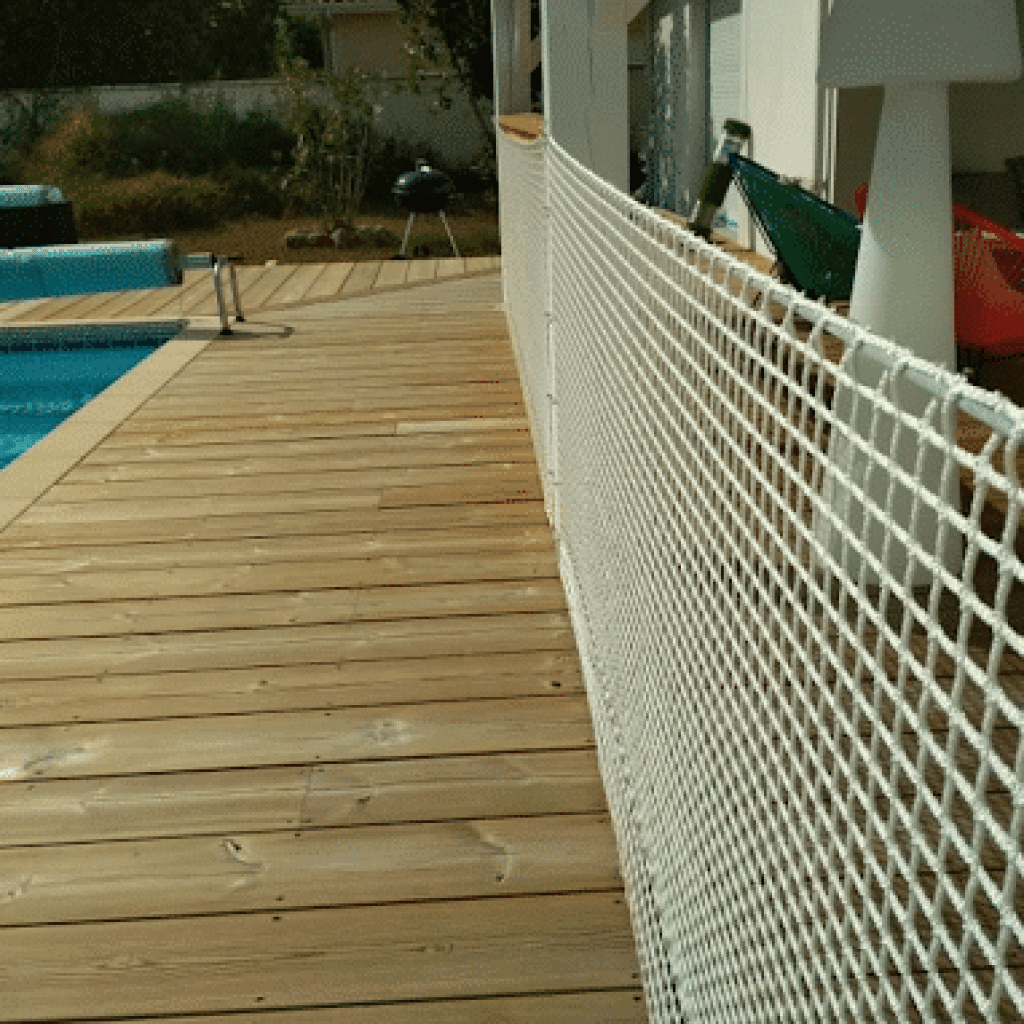
The first type of pool safety net is installed directly above the pool, stretched over the surface to prevent falls into the water. The second type is fixed around the pool’s perimeter, often on the coping or just around the pool, forming a flexible barrier.
What about deck safety netting? It is mainly used as a railingin this case stretched vertically to secure the edges and prevent falls into the void. It can also be attached to the underside of an openwork or raised terrace, to prevent objects or animals from falling.
Installation and maintenance of outdoor protection netting
Installation of safety nets is not to be taken lightly, and must be carried out with precision to guarantee their effectiveness. To this end, it’s essential to use sturdy fasteners, adapted to supports such as walls, floors or railings, using bridges, plates or tensioning ropes. For this reason, installation by experienced professionals is highly recommended.
And once installed, these solutions require very little maintenance– just regular visual inspection, cleaning with clear water and checking the fastening points. Do you notice a loose, worn or damaged mesh while you’re doing it? In this case, rapid replacement of the mesh is highly recommended. Bear in mind that a well-laid and maintained net retains its safety and resistance properties over time, and its appearance remains unchanged.
Whether you’re planning tobuy a swimming pool safety net, or a deck safety net, Feelnets can support you with its expertise and reliable, aesthetic , tailor-made solutions for every outdoor configuration.