
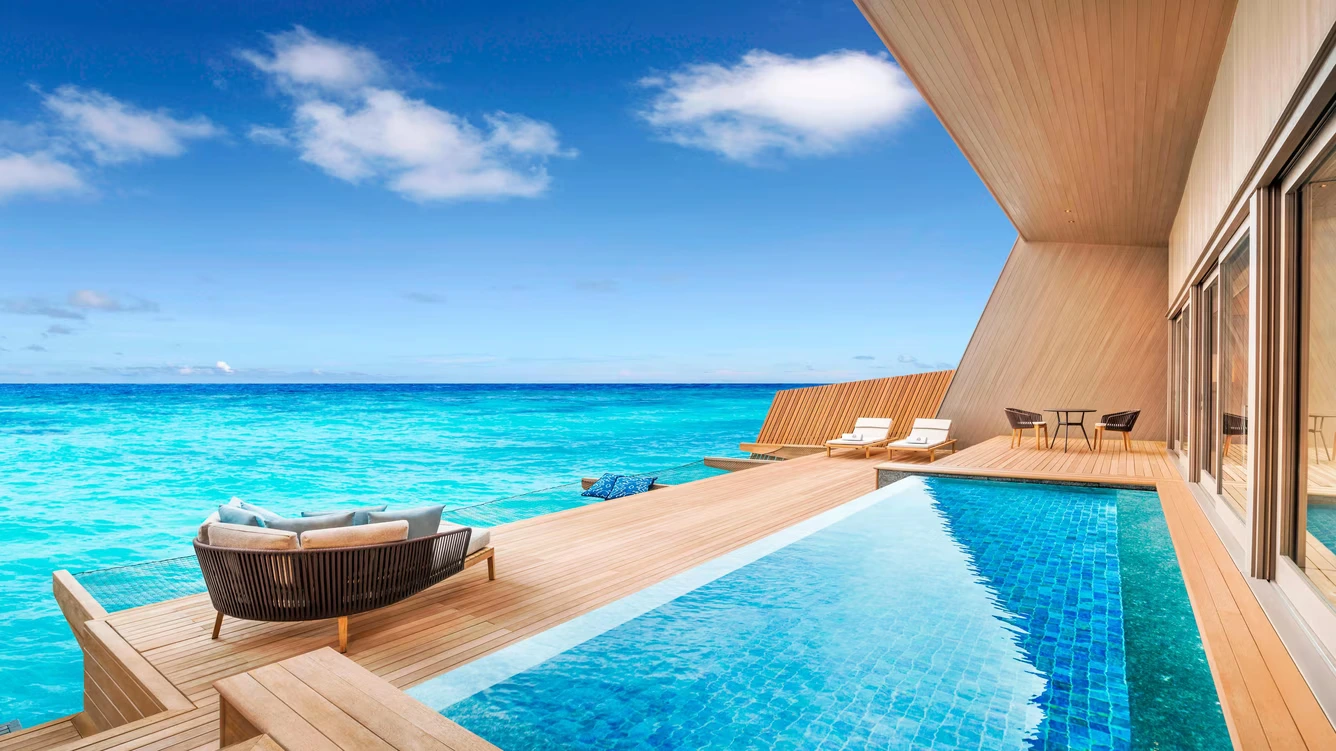
There is a moment — familiar to anyone who has stayed in the right hotel — when you walk into a room or step onto a terrace and immediately want to take a photograph. Not of the view. Of the space itself.
Increasingly, that moment is created by a net.
From Function to Signature
Custom nets have been part of the hospitality industry for decades, primarily as safety features: barriers on elevated terraces, pool perimeters, or open-sided bungalows. What has shifted dramatically in recent years is the role design plays in how they are specified.
Where a generic railing once closed off a terrace, a tensioned net now opens it up. Where a balcony once needed a visual barrier, a fine-mesh installation now frames the horizon without interrupting it. The net has moved from afterthought to architectural signature.
More than 200 hotels worldwide have now partnered with Feelnets to bring this approach into their spaces — from boutique properties in the French Alps to overwater bungalows in the Maldives.
The Sunbed Net: A Category of Its Own
The most distinctive evolution in hospitality net design is the integrated sunbed net: a tensioned mesh surface suspended within a frame at terrace or deck level, replacing the traditional sun lounger with something far more immersive.
Guests don’t sit on it — they sink into it. The mesh conforms to the body, allows airflow from below, and creates a sensation that no cushioned furniture can replicate. Photographed from above, it has become one of the most shared hotel images on social media.
For hotels, the value is compounded. A sunbed net is virtually maintenance-free compared to upholstered outdoor furniture: no fabric to replace, no cushions to store seasonally, no mold risk. The initial investment pays for itself over multiple seasons.
Designing for Atmosphere, Not Just Function
The most successful hotel net installations share one quality: they were designed for the experience they create, not merely the problem they solve.
Color selection matters enormously at this scale. White nets photograph beautifully against blue water and sky — which is why they dominate coastal and island properties. Beige and ecru integrate into warm stone or timber environments without drawing attention to themselves. For rooftop installations in urban settings, darker tones create a sophisticated tension against the skyline.
Mesh size shapes the experience too. Finer meshes feel refined and almost textile-like, appropriate for luxury interiors. Larger meshes introduce a more raw, architectural quality suited to design hotels and contemporary resort spaces.
What Guests Actually Say
Guest feedback on net installations clusters around three themes: comfort, novelty, and the feeling of connection to the surrounding environment. The absence of solid barriers — walls, railings, opaque panels — creates a psychological openness that guests consistently describe as relaxing.
The social dimension is equally real. Shared sunbed nets designed for two create an intimacy that standard side-by-side loungers do not. In hotel photography and on social platforms, they generate organic content that no marketing budget can easily replicate.
A Practical Note for Hospitality Buyers
Custom nets a hotel design feature involve a few specific considerations beyond residential installations. Surface areas are typically larger, requiring precise structural assessment of anchor points. Specifications must account for continuous daily use rather than occasional residential load. And lead times should be planned into renovation or opening schedules early.
Feelnets works directly with hotel architects, interior designers, and project managers — providing technical drawings, material samples, and on-site guidance where needed. The result is an installation built to the property’s exact requirements, not adapted from a standard product.
In hospitality, details create loyalty. A net that makes a guest stop, sit down, and never want to leave is one of the most cost-effective investments a property can make.