



A guardrail net is installed vertically to secure a staircase, mezzanine, balcony, or terrace, while still allowing light and a clear view. This guide answers the questions you might have before placing an order: which safety standards to follow, which mesh size to choose, whether to use netting or rope, which fasteners to use, and how to install it. For prices, colors, and a quote, visit our custom guardrail netting page.
Height and Standards for a Mesh Guardrail
A guardrail must prevent falls, but it must also prevent a child from slipping through the gaps between its components. This is the requirement set forth in standard NF P01-012, the industry standard for building guardrails, whether they are made of railings, glass, or mesh. It was revised in November 2024 and replaces the 1988 version.
What should be the height of a mesh railing?
For a balcony or terrace, the minimum height of a railing is generally 1 m. It depends on the layout: it can be increased if there is a ledge or a nearby elevation change, and reduced if the support is thick. Feelnets recommends a net height of 1.10 m. For stairs, a mezzanine, or a low window, the rules vary: let us know your specific setup, and we’ll advise you.
What is the maximum spacing between the components?
In general, the gaps in a railing must not allow a 11 cm gauge to pass through, which corresponds to a child’s body size. The mesh sizes offered by Feelnets for guardrails (13×13, 30×30, and 48×48 mm) are all within this limit.
For a rope railing, you determine the spacing between the ropes, so you need to keep this in mind from the design stage. The spacing to be observed is the clear space between two ropes, not the distance between their centers: the thicker the ropes, the farther apart they can be spaced center-to-center, provided the gap does not exceed 11 cm. If you’re unsure, tell us about your project and we’ll work with you to determine the spacing before manufacturing.
Nets certified to EN1263-1 and compliant with NF P01-012
The NF P01-012 standard defines the dimensions of the guardrail: its height and gaps. The EN1263-1 certification covers the net itself: load resistance, edge strength, and fixing reliability. Feelnets guardrail nets meet both requirements. For more information, please visit our quality and safety page.
If your railing is subject to planning permission or building codes, check with your architect or a building professional to determine the applicable requirements, or contact us to determine the appropriate height and spacing.
What mesh size should you choose for a railing?
The mesh size determines what the netting allows to pass through: light, a view, but also hands, feet, and small objects. Three mesh sizes are available for guardrails.
- 30×30 mm, polyester ³⁺: the most versatile. Airy and bright, it’s suitable for both indoor and outdoor use and comes in 7 colors.
- 13×13 mm, polyester ³⁺: the safest option when young children are present, as it traps small objects. It has a denser appearance and lets in slightly less light. Available in white and black.
- 48×48 mm, polyamide: the most discreet and transparent, recommended for indoor use. Available in white, black, and beige.
The three mesh types can support up to 210 kg/m². For a detailed comparison, see our Guide to Choosing the Mesh Size for Your Net.
Net or rope: which should you choose?
The mesh forms a continuous surface and provides protection along the entire height.
The rope guardrail, on the other hand, consists of tension ropes stretched vertically: more graphic and visually lighter, it is suitable for open staircases and mezzanines where design takes precedence. Spacing, thickness, and color (natural beige, white, or black) can be customized.
When safety takes precedence over aesthetics, the net remains the preferred choice. Both solutions can be combined with a horizontal mezzanine net.
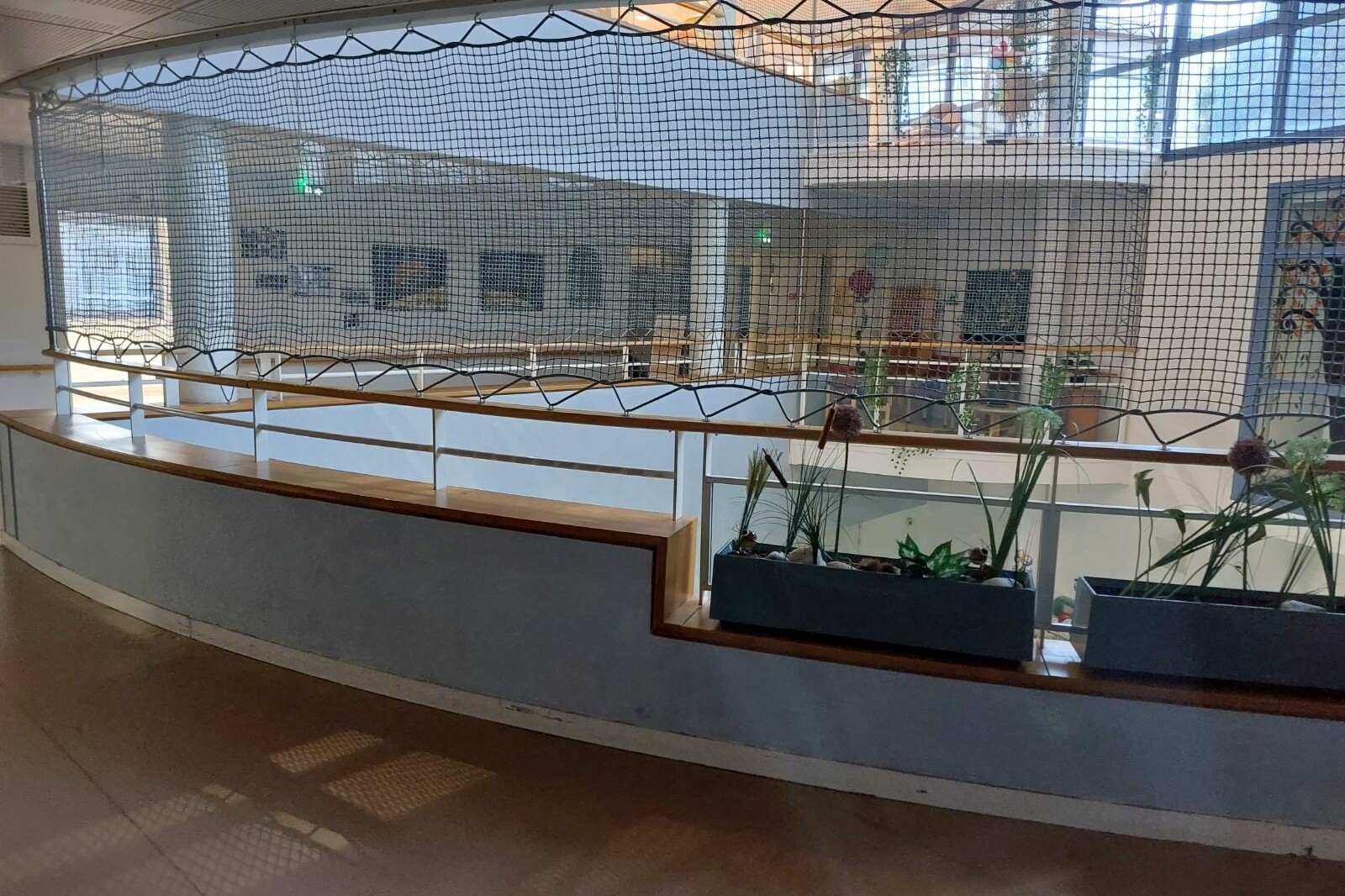
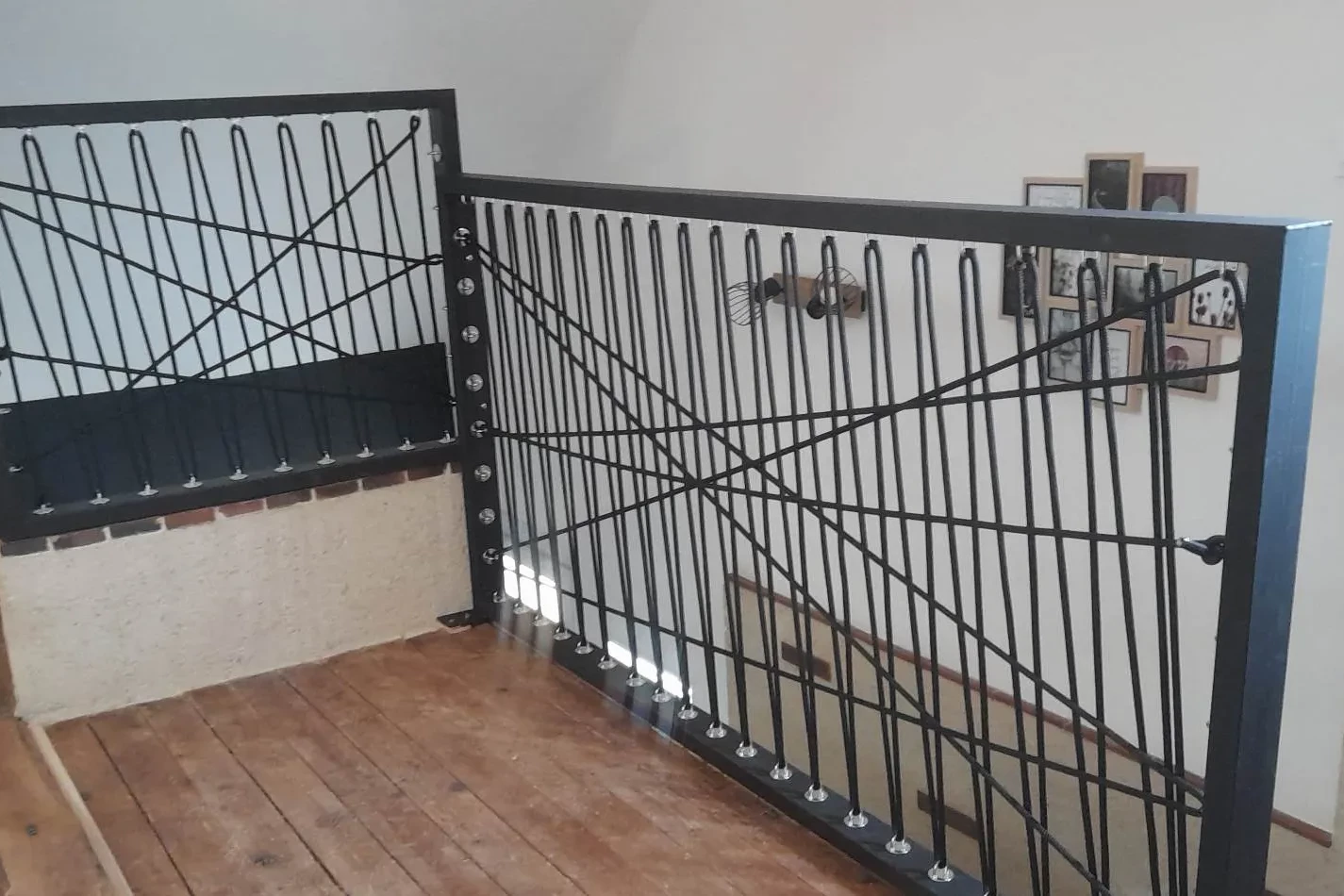

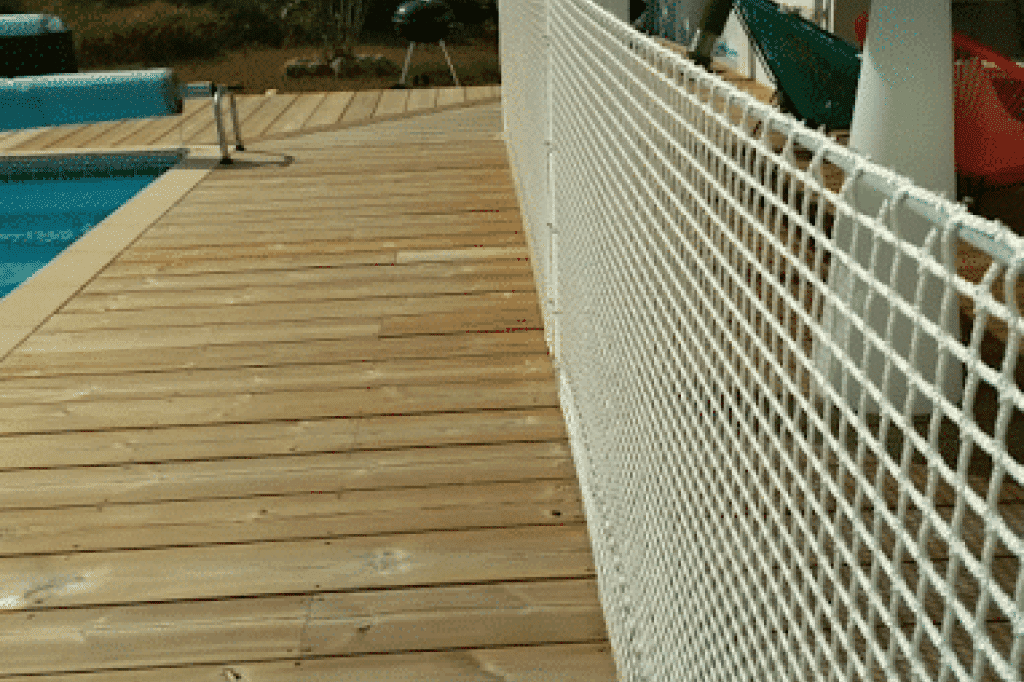
Mounts and Tension
On a vertical guardrail, plate-mounted brackets are the most commonly used fasteners because of their flat, unobtrusive appearance. The horseshoe-shaped bracket, which is more compact, is an option reserved for this vertical application. Depending on your mounting surface (wood frame, concrete with a suitable anchor, or metal structure), Feelnets selects and includes the appropriate fasteners—manufactured in Europe—with every order.
The net is then tensioned using the tensioning cord included with your order. When properly tensioned, it will have no folds or dips—this is essential for it to fully fulfill its protective function. To learn everything you need to know about mounting options for your specific surface, consult our net mounting guide.
Installing a guardrail net
At Feelnets, 96% of customers install their nets themselves—in pairs—using just a screwdriver. Each order comes with a net custom-made to the exact dimensions of your project, fasteners suited to your mounting surface, tensioning cord, and detailed installation instructions.
Before installing
, make sure your railing has a sturdy support all around it: a wooden frame, concrete, or metal structure. The netting must be secured on all sides to be both functional and aesthetically pleasing. If you don’t have a frame, you’ll need to have one built: a carpenter, joiner, or metalworker can handle this, and we can put you in touch with one of our partner contractors.
Installation Steps
- Mark the mounting points, spaced evenly around the entire perimeter (approximately every 150 mm).
- Install the fasteners: brackets on a mounting plate or horseshoe brackets, either directly into the wood or using appropriate anchors in concrete.
- Position the net against the frame, ensuring it is properly aligned, before applying any tension.
- Lace the net with the tension cord, then tighten it gradually and evenly, side by side, until there are no folds or sags.
On an existing railing
If you already have a railing, the net covers it on the inside, and it is tensioned using rope threaded between the railing and the edge of the net.
For installations at height or on projects involving heavy loads, we recommend hiring a professional: Feelnets works with a network of partner contractors throughout France— please contact us. Installation steps are detailed step-by-step in our net installation guide, and information on selecting fasteners is available in our fastener guide.
Which railing is right for your situation?
Stair Railing Mesh
Recommended mesh size: 30×30 mm or 48×48 mm, polyamide
The netting replaces or complements an existing railing and secures open sides without blocking light. It can also be stretched from floor to ceiling along the staircase. Custom-made, it adapts to straight, spiral, or quarter-turn staircases, both indoors and outdoors. Commonly used on floating wooden staircases, designer metal structures, and double-height spaces.
Guardrail netting for mezzanines and hoppers
Recommended mesh size: 30×30 mm or 48×48 mm, polyamide
The horizontal mezzanine netting creates the walkable surface, while the vertical guardrail netting secures the perimeter: access shaft, open side over a void, or full balustrade. Both are ordered together in the same colors.
Outdoor Guardrail Netting: Balconies and Patios
Recommended mesh size: 30×30 mm Polyester ³⁺
A traditional railing may have gaps between its components: the netting forms a continuous barrier, allows air to circulate, and preserves the view. It can also be installed over an existing wooden or steel railing. With the right mesh size, it keeps both children and pets from falling through. UV-treated, it is weather-resistant and requires only a simple rinse with clean water once a year.
Children's Room and Bunk Bed
Recommended mesh size: 13×13 mm or 30×30 mm Polyester ³⁺
Made to the exact dimensions of the bed or frame, the net prevents falls without taking up space or blocking light. The 13×13 mesh catches small objects, though it results in a denser appearance.
Maintenance of a Guardrail Net
Rinsing with clean water once a year is sufficient for maintaining a guardrail net. For a more thorough cleaning, wash it in cold water or at a maximum temperature of 30°C using a mild detergent—without bleach or fabric softener—then let it air dry, away from direct sunlight. The complete method is detailed in our guide to cleaning safety nets. Also, be sure to check the tension and condition of the fasteners from time to time: a net should remain taut, without any wrinkles or sagging.
Do you know what height and mesh size you need? Get your personalized quote in less than 3 hours. Mounting hardware and tensioning ropes are included.
Not sure about your setup? Our team is available by phone, email, or WhatsApp.
FAQ: Frequently Asked Questions About Guardrail Nets
What height should a net railing be?
The minimum height for a balcony or terrace railing is generally 1 m according to standard NF P01-012. This varies depending on the height and thickness of the support. Feelnets recommends a net height of 1.10 m. Please specify your configuration in your quote request: we will advise you before manufacturing.
Which standard applies to a net guardrail?
The NF P01-012 standard governs the height and gaps of building guardrails, whether or not they include netting. The EN1263-1 certification covers the netting’s resistance. Feelnets guardrails meet both requirements.
What is the maximum spacing between the components of a guardrail?
In general, the gaps must not allow a 11 cm gauge to pass through, which corresponds to a child’s body size. Feelnets mesh sizes for guardrails (13×13, 30×30, and 48×48 mm) all fall below this limit. For a rope guardrail, the gap between two ropes must also remain below this limit: we determine the spacing with you before manufacturing.
What is the difference between a guardrail net and a mezzanine net?
The mezzanine net is installed horizontally and creates a walkable surface. A guardrail net is installed vertically to secure a staircase, mezzanine, balcony, or terrace. Both can be ordered together, custom-made, and in the same colors.
Net or rope for a stair railing?
The net forms a continuous surface: this is the preferred choice when safety takes precedence over aesthetics, especially with young children. Rope railings are suitable for open staircases where design is paramount: spacing, color, and thickness are custom-made, with the gap between two ropes remaining below the standard 11 cm.
Can you install a guardrail net yourself?
Yes, in standard cases: 96% of our customers install their nets themselves, in pairs, using a power drill, following the instructions included with the order. For installations at height or on projects involving heavy loads, we recommend hiring a professional, and we can put you in touch with one of our partner contractors.
How do you maintain a guardrail net?
Rinsing it with clean water once a year is sufficient. For a more thorough cleaning, wash it in cold water or at a maximum temperature of 30 °C using a mild detergent—without bleach or fabric softener—and let it air dry.