

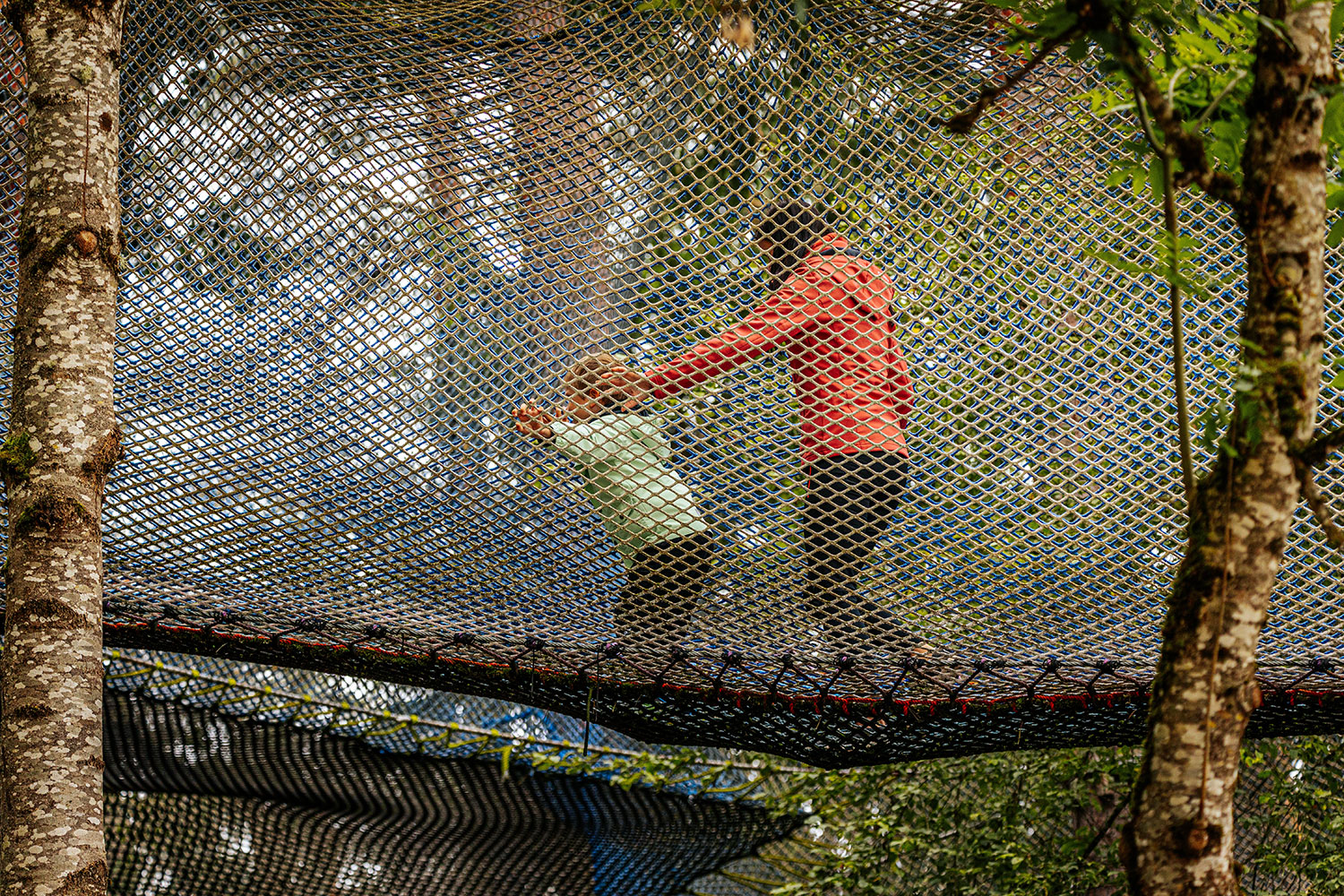
What Is a Tree Net?
A tree net is a horizontal net suspended between trees, strong enough for people to sit, lie or bounce on. Think of it as a hammock and a treehouse floor combined. A small DIY tree net can cost a few hundred dollars in rope, while professionally rigged or custom-made nets often run into the thousands.
Tree nets give you a place to relax in the canopy without building a heavy structure. They do put real loads on living trees, however. This guide covers design, realistic costs and the attachment choices that protect both the people on the net and the trees holding it.
How to Design a Tree Net
Start with the trees, because they set the shape, the size and the height of your net. Then decide whether you want to weave the net on site or order one made to measure.
| Woven tree net | Made-to-measure net | |
|---|---|---|
| How it is built | Rope perimeter rigged in the trees, then filled by hand | Manufactured to your dimensions, then laced to anchor lines |
| Typical fill | Paracord or similar cord | Polyester mesh or PVC mesh |
| Look | Organic, web-like | Clean, even surface |
| Time on site | Long, often several days of weaving | Shorter, mainly rigging and tensioning |
| Best for | Hobbyists who enjoy the process | Owners who want a finished surface and consistent mesh |
Choosing the right trees
Healthy, mature trees with sound trunks make the best anchors. The International Slackline Association recommends a minimum anchor diameter of about 12 inches (30 cm) for slacklines, and more at higher tension. Treat that figure as a floor for a net, since a net can carry several people.
Bark matters too. Thick-barked species such as oak and chestnut tolerate slings better than thin-barked beech. Avoid trees with deadwood, cavities, fungus or a recent lean, and ask a certified arborist to inspect them.
Shape and size
Three trees create a triangle, which is simple to tension and suits small groups. Four trees give you a larger, more regular lounging area. Feelnets makes nets in triangular and irregular shapes, so uneven tree spacing does not rule out a custom design.
Keep the net low. Lower nets are easier to reach and inspect, and a fall is less severe. Remember that trees sway independently, so the design must absorb movement instead of fighting it.
Rope and mesh
Polyester is a strong choice for outdoor use because it resists UV and abrasion and stretches little. Avoid polypropylene, which degrades quickly in sunlight. Feelnets’ outdoor nets use high-tenacity polyester with anti-UV treatment, in 13 mm or 30 mm mesh.
How to Install a Tree Net Safely
A safe tree net depends on the anchors more than the mesh. Near-flat lines multiply the pull on each anchor, so the force on a tree can far exceed the weight of the people on the net. Hire a qualified rigger for any net above low height or any net used by children.
Tree attachment methods compared
Wide tree slings
How it works: A padded strap wraps a trunk or sturdy fork
Advantages: No drilling, easy to adjust
Drawbacks: Needs regular inspection; can harm the tree if left unchecked
Treehouse attachment bolt
How it works: A large engineered bolt enters the trunk
Advantages: High load capacity, low maintenance
Drawbacks: Higher cost, creates a wound, needs a sound trunk
Through-bolt
How it works: Threaded rod passes through the trunk
Advantages: Low cost, strong pull-out resistance
Drawbacks: Drilled core can spread decay; suits lighter horizontal loads
Bare rope wrapped around the trunk
How it works: Rope tied directly to the tree
Advantages: Cheap
Drawbacks: Cuts into bark and can girdle the tree. Avoid it.
No method suits every tree. Treehouse specialists report that well-placed bolts often cause less long-term harm than wrapping or clamping. Any injury to bark and tree tissue can let in pests and disease. A certified arborist can weigh those risks for your species and site.
Why girdling matters
Girdling happens when something tight around a trunk or branch damages the tissue that moves sugars through the tree. Severe cases can kill the branch or the whole tree. Trunks keep growing, so a strap that fits today can become a problem later.
Installation checklist
- Have an arborist assess every anchor tree.
- Use slings at least 2 inches (5 cm) wide, with felt or similar padding beneath them.
- Keep anchors on the main trunk or a strong fork, not on outer branches.
- Tension the net gradually and evenly, then recheck it after the first few uses.
- Test the net with weight close to the ground before anyone climbs on.
- Clear the area below of rocks, stumps and sharp objects.
- Set a clear limit on the number of users.
Do not assume every net suits this job. We advise against suspending its hammock netting between trees without a frame. Always confirm that your net and hardware are approved for tree mounting.
How to Maintain a Tree Net
Inspect the trees and hardware at least every three months, and after every major storm. Look for bark indentation, frayed rope, loose fittings and new deadwood overhead. Move or loosen slings as the trunks grow, and replace them on schedule. One German standard calls for replacing tree loops every eight years.
For the net itself, rinse polyester with clear water once a year. Our guide to net lifespan and care explains what to watch for over time.
Frequently Asked Questions
Do tree nets hurt trees?
They can if the attachments are too narrow, too tight or left unchecked. Wide padded slings, or properly placed engineered bolts, and regular inspection greatly reduce the risk.
How much rope do I need for a tree net?
Builders report anywhere from about 165 feet for a small net to 400 feet for a larger one. That covers the perimeter and layout, and woven designs need extra cord for the fill.
How much weight can a tree net hold?
The limit depends on the net, the anchors and the trees. Feelnets rates its nets at 200 kg per square meter (about 41 lb per square foot), but your weakest anchor sets the real limit.
Is a tree net the same as a treehouse net?
Not quite. A tree net hangs directly between trees. A treehouse net usually fills an opening in a platform or frame, which makes the anchors simpler to design.
Can I leave a tree net up all year?
A UV-treated net can stay outdoors, but heavy snow and storms add load. Taking the net down for winter also gives the anchor points a break.
Plan Your Tree Net with Feelnets
Feelnets has made custom nets for more than ten years, for homes, hotels and catamarans around the world. Each net is built in France to your exact dimensions, and production takes 10 to 15 working days after you validate the quote. Share your tree spacing and photos through the net design tool, or request a free quote to get started.