
There’s a particular kind of property where a deck, a dock, and open water all meet — and where the space in between is usually wasted. Lake houses, cottages, and waterfront resorts pour money into the dock itself and the shoreline landscaping, but the zone that connects them is often left as bare boards or, worse, empty air over the water. That’s exactly the space a custom dock net is built to claim.
What Is Dock Netting, Exactly?
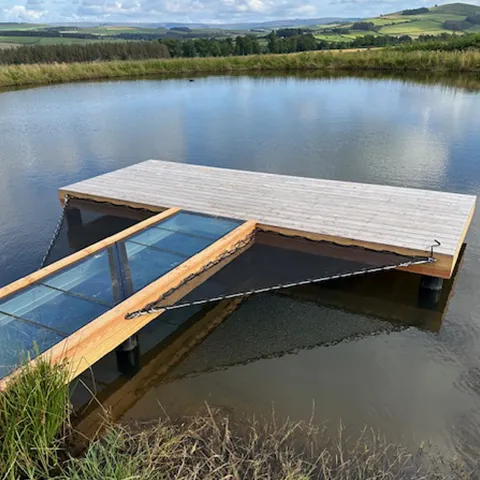
Dock netting is a marine-grade net suspended between dock posts, pilings, or a dedicated frame, creating a stable surface — or a soft, hammock-like one — directly over the water. Depending on how it’s installed, it can serve two very different purposes: a taut, walkable net that turns unused space beside or beneath a dock into a lounging platform, or a looser, cradle-style net designed purely for relaxing above the water’s surface.
Feelnets builds both versions to measure, using the same marine-grade mesh developed for our catamaran trampoline nets — material that’s already proven itself against sun, salt, and constant moisture on boats sailed year-round.
Why It’s the Upgrade Most Waterfront Properties Are Missing
1. It Turns Dead Space Into the Best Seat on the Property
The stretch of water beside a dock, under a boathouse, or off the end of a pier is rarely used for anything. A net installed there becomes the spot everyone ends up — close enough to the water to dangle a hand in it, comfortable enough to stay for hours. It’s usable square footage that doesn’t require a single extra board of decking.
2. It Adds a Real Safety Barrier
For families with young children or pets, open water at the edge of a dock is a constant, low-level worry. A properly tensioned net around a swim platform or between dock sections acts as a physical barrier without blocking the view or the breeze — a very different solution from a rigid rail, and one that suits the relaxed character of a lake property.
3. It’s a Signature Feature for Rental and Resort Properties
For cottage owners renting on Airbnb or VRBO, and for lakeside or coastal resorts competing for bookings, a net suspended over the water is the kind of feature that photographs itself. It reads as considered, high-end design rather than standard dock furniture — the same effect Feelnets nets have already created for boutique hotels working with overwater and terrace installations.
4. It’s Engineered for Water, Not Just Weather
A garden hammock or a generic outdoor net isn’t built for constant proximity to water — freshwater algae, fluctuating humidity, and in coastal settings, salt spray all shorten the life of ordinary materials fast. Dock netting needs the same resistance profile as marine rigging: UV-stabilized, rot-proof, and tensioned to handle the movement of a structure that’s partially over water.
5. It Complements Everything Already on the Water
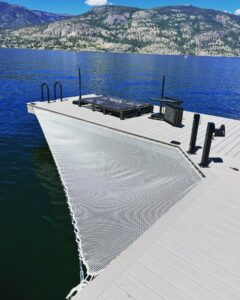
Unlike a deck extension or a permanent structure, a net installation works with an existing dock rather than requiring you to rebuild it. It can be fitted around ladders, cleats, and boat slips, and it’s just as suited to a quiet freshwater lake dock as it is to a busy coastal marina frontage.
Built for the Property, Not Off a Shelf
Every dock is different — different piling spacing, different heights above the waterline, different exposure to wind and current. That’s precisely why standard, pre-cut netting rarely fits well over water. A made-to-measure net, sized and tensioned for the specific structure it’s attached to, is what actually holds up season after season.
Feelnets has spent over a decade making marine-grade nets for boats sailed in open water worldwide — the same expertise now shapes our dock and waterfront netting for homes, cottages, and resorts.
Dock & Waterfront Netting Contact us to receive a custom quote
Receive your quote in less than 3 hours! Request your Free Quote