
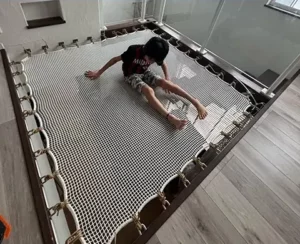
Short answer: they are often the same product sold under different names. A loft net (or mezzanine net) is a tensioned net installed horizontally to create a suspended floor, play space or reading area. A hammock floor is the same product, named for how it feels rather than what it does. A trampoline net is the marine original — the mesh deck stretched between the hulls of a catamaran — and the name followed the material indoors. A balustrade net is the one that is genuinely different: it is installed vertically, as a barrier rather than a surface.
If you are trying to describe what you want to an architect, a builder or a manufacturer, that distinction between horizontal surface and vertical barrier matters far more than which of the names you happen to use.
Why does one product have so many names?
Because it arrived from three directions at once.
Suspended mesh has been used at sea for decades, where it is called a trampoline. Architects began specifying similar mesh indoors and described it by its function — a mezzanine, a loft floor. Meanwhile homeowners who lay on one for the first time reached for the most obvious comparison available, and called it a hammock.
None of those names is wrong. They simply come from different worlds, and none of them has won. The result is a category where searching for one term hides half the market from you, and where two suppliers can quote for what sounds like different products and deliver the same thing.
What is a loft net?
A loft net, also called a mezzanine net, is a net tensioned horizontally across an open space — typically a void above a living room, a landing, or the open side of a mezzanine level.
It creates usable area where there was only air. People use loft nets as reading corners, play spaces, guest sleeping areas, and as a way to make a double-height room feel connected rather than divided. In tight footprints — tiny houses, converted attics, small apartments — it adds floor without adding structure.
The term is the most useful one to use with architects and builders, because it describes the architectural function rather than the sensation.
What is a hammock floor?
A hammock floor is a loft net. The term describes the experience: the slight give underfoot, the way the mesh takes the shape of whoever is lying on it.
It is worth knowing the term exists, because it is what many homeowners search for and what a lot of interior-design coverage uses. But it is a consumer word rather than a trade one. Ask a structural engineer for a hammock floor and you may get a puzzled look; ask for a tensioned mezzanine net and you will not.
One practical distinction: “hammock floor” is almost always used for indoor residential installations. Nobody calls a sports barrier or a hotel terrace net a hammock floor.
What is a trampoline net?
This is where the material originally comes from. On a catamaran or trimaran, the trampoline is the mesh deck stretched between the hulls — walked on, sat on, slept on, and exposed permanently to sun, salt and movement.
Those conditions produced a mesh that is strong, dimensionally stable, comfortable against skin and highly UV-resistant. When designers started looking for something to span an indoor void, marine trampoline mesh was already solving a harder version of the problem.
So “trampoline net” can mean two things: the actual deck on a multihull, or an indoor net made from the same marine-grade material. In a boating context it is precise. In an architectural context it tends to confuse, because most people hear it and picture a garden trampoline with springs — a completely unrelated product.
What is a balustrade or railing net?
This one is genuinely a different product, and the difference is orientation.
A balustrade net is installed vertically. It fills the gap in a stair rail, a landing edge or a mezzanine guard, functioning as an infill panel rather than a surface. Nobody sits on it. Its job is to stop things — usually children, pets, or objects — passing through a gap.
Because it is a barrier rather than a floor, the design priorities change. Mesh aperture matters more than comfort. It is also the net most likely to interact with building regulations, since it is doing the work a guard or balustrade would otherwise do.
Confusing the two is the most consequential naming error in the category, and it happens often. A net specified as a floor and a net specified as a barrier are not interchangeable.
Horizontal or vertical: the distinction that actually matters
| Name | Orientation | Typical use | What it is for |
|---|---|---|---|
| Loft net / mezzanine net | Horizontal | Voids, mezzanines, landings | A surface to occupy |
| Hammock floor | Horizontal | Residential interiors | A surface to occupy |
| Trampoline net (marine) | Horizontal | Between catamaran hulls | A deck to move on |
| Trampoline net (interior) | Horizontal | Indoor voids | A surface to occupy |
| Balustrade / railing net | Vertical | Stair rails, guards, mezzanine edges | A barrier to stop passage |
| Terrace and balcony net | Either | Outdoor living space | Surface or barrier |
| Sports and golf netting | Vertical | Pitches, ranges, courts | Containment |
Everything above the balustrade row is a surface. Everything from it down is either a barrier or containment. Get that right and the vocabulary sorts itself out.

Which term should you use?
Talking to an architect, builder or engineer: use mezzanine net or tensioned net, and say horizontal or vertical explicitly. These are functional terms that map onto how they think about a building.
Searching online: try several. Loft net, hammock floor and mezzanine net surface noticeably different results, and you will otherwise miss suppliers who use the other word.
Requesting a quote: the name matters less than four pieces of information — orientation, the dimensions of the opening, what the net will be fixed to, and who will use it. Any manufacturer worth dealing with will ask for those regardless of what you called it.
Talking about boats: trampoline is correct and unambiguous. Use it.
Frequently asked questions
Is a hammock floor the same as a loft net? Yes. Same product, different name — one describes the feel, the other the function.
Can you walk on a loft net? Yes, though it flexes underfoot and takes a moment to get used to. Suitability depends on the specification, so confirm intended use with your manufacturer before ordering.
Is an indoor net the same as a garden trampoline? No. A garden trampoline uses springs and a solid frame to bounce. An interior net is a tensioned mesh surface with no spring system.
What is the difference between a balustrade net and a loft net? Orientation and purpose. A balustrade net is vertical and acts as a barrier; a loft net is horizontal and acts as a surface.
Can the same mesh be used indoors and outdoors? Marine-grade polyester mesh is designed for permanent UV and salt exposure, so it performs indoors and out. Cheaper fibres often do not survive sustained sunlight.
What should I send a manufacturer to get a quote? Orientation, opening dimensions, a photo of the space, what the fixings will go into, and how the net will be used.
Feelnets has manufactured made-to-measure nets in Quimperlé, France since 2012, for homes, hotels and multihulls worldwide. If you are unsure which product fits your space, send us your dimensions and a photo and we will tell you what you need.