




Winterizing Outdoor Nets: How to Store, Clean and Protect Them Until Spring
Why winter is the real test for an outdoor net
A well-made outdoor net handles summer sun, rain and daily use without complaint. Winter is different. Months of standing water, freeze–thaw cycles, wet leaves and low light give dirt and algae time to settle into the mesh.
The good news: twenty minutes of care in autumn adds seasons to the life of your net. Whether it stretches over a patio, a deck, a pool terrace or a lakeside dock, the routine is the same. Clean it, dry it fully, store it properly and check the fixings before spring.
This guide walks you through each step, and helps you decide whether your net should come down at all.
Should you take your outdoor net down for winter?
In most climates with real winters, yes. Taking the net down is the simplest way to protect both the mesh and the structure it hangs from. It also lets you clean it properly.
Take it down if:
- Your area gets snow. Snow load on a horizontal net puts heavy, prolonged strain on the mesh, the edge rope and every anchor point.
- The net sits under trees and collects leaves, pine needles or sap.
- The structure is wooden and needs its own seasonal maintenance.
- The site is unused for several months, such as a holiday home or a seasonal cottage.
You can leave it up if:
- Your winters are mild and dry, with no snow and little frost.
- The net is used year-round, for example on a covered terrace or in a warm climate.
- You can inspect it regularly and brush off debris after storms.
If you are unsure, take it down. Removing and refitting a net with good mounting hardware takes far less time than replacing a damaged one.
How to clean an outdoor net before storing it
Never store a dirty net. Organic matter left in the mesh over winter feeds mould and leaves stains that are hard to shift by spring.
- Choose a dry, mild day. You need several hours of dry weather after washing, so check the forecast first.
- Brush off loose debris. Remove leaves, needles and dust with a soft broom while the net is still tensioned. This is far easier than picking debris out of a slack net.
- Wash with mild soapy water. Use lukewarm water and a gentle detergent or neutral soap. Work it into the mesh with a soft brush or sponge.
- Treat stains gently. For green algae or bird droppings, repeat the soapy wash and let it sit for a few minutes before brushing.
- Rinse thoroughly. A garden hose on a low setting is enough. Soap residue attracts dirt, so rinse until the water runs clear.
What to avoid:
- Pressure washers. A high-pressure jet can fray fibres and loosen knots or braiding.
- Bleach and harsh solvents. They weaken synthetic fibres and can fade colours.
- Stiff wire brushes. They abrade the surface of the cord.
For a deeper routine, including stain-specific tips, see our complete guide to cleaning and maintaining your home net.
Drying, folding and storing your net
Drying is the step people rush, and it is the one that matters most. A net packed away even slightly damp can develop mildew within weeks.
Dry it completely. Leave the net tensioned in place after rinsing, or drape it over a railing or clothesline. Let air circulate on both sides. Direct sun helps, but the net must be dry to the core of every cord, not just on the surface.
Detach it carefully. Release the tension evenly, side by side, rather than freeing one corner at a time. Keep the edge rope or lacing attached to the net if you can, so refitting in spring is quicker.
Fold, don't crumple. Fold the net loosely in large panels, or roll it around a tube. Avoid sharp creases, tight knots and heavy objects pressing on it.
Store it somewhere dry and ventilated. A breathable cotton bag or a large storage box with air holes works well. Avoid sealed plastic bags, which trap moisture.
Good storage spots:
- A dry garage shelf, off the floor
- A loft or attic that does not get damp
- A utility room or cupboard inside the house
Keep the net away from rodents, sharp tools, fuel, solvents and heat sources such as boilers or radiators.
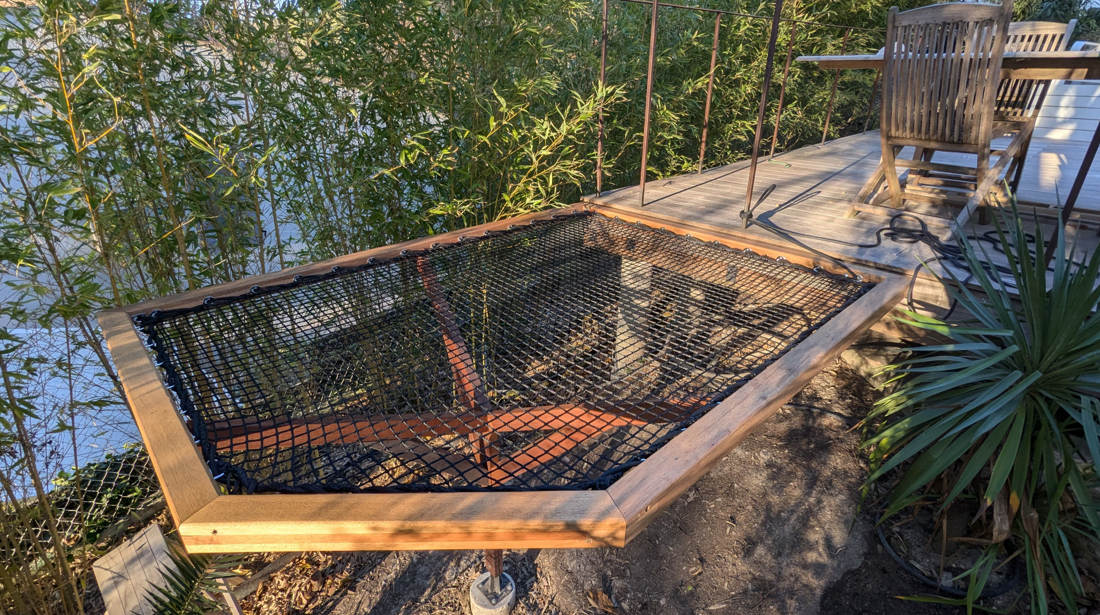
Don't forget the hardware
The net is only as strong as what holds it. Once it is down, take a few minutes to inspect every fixing point.
- Anchors and eyebolts. Check they are still firmly seated. Look for cracks in wood or concrete around them.
- Turnbuckles and tensioners. Clean off grit, check the threads and apply a light coat of marine grease if they are metal.
- Steel cables. Look for broken strands, kinks or corrosion, especially near crimps and clamps.
- Lacing cord or edge rope. Replace any section that looks frayed, hardened or discoloured.
If the hardware is easy to remove, store it in a labelled bag with the net. If it stays on the structure, cover open threads to keep water out.
Not sure which fixings suit your setup? Our guide on choosing mounting hardware for a custom net explains the options.
If your net stays up all winter
Some nets are built to stay in place: a hotel terrace in a warm climate, a covered veranda, a dock net in a region with mild winters. In that case, a light routine keeps it in good shape.
- Release some tension. A slightly relaxed net copes better with temperature swings and any unexpected load.
- Clear it after every storm. Brush off leaves, branches and standing water before they settle.
- Never let snow build up. If snow falls, sweep it off gently with a soft broom. Do not walk or lie on a snow-covered net.
- Check it monthly. Look at the anchor points, the edge rope and any spot where the mesh rubs against the structure.
- Close it to use when frozen. Ice makes cords stiff and slippery, so keep people off until it thaws.
For waterfront nets, also watch for ice forming on the water below and spray reaching the mesh. Our article on dock and waterfront netting covers lakeside installations in more detail.
Spring reinstallation checklist
When the weather turns, run through this list before the first lazy afternoon on your net.
- Unpack the net and air it outdoors for a few hours
- Inspect the mesh, panel by panel, for cuts, fraying or loose knots
- Check the edge rope and lacing along the full perimeter
- Confirm every anchor point is solid and undamaged
- Refit and tension the net evenly, side by side
- Test it with gentle weight before full use
- Replace any worn hardware rather than waiting for midsummer
If you find damage you are unsure about, send a photo to the Feelnets team. Small repairs are often possible, and catching them early avoids bigger problems later.
Frequently asked questions
When should I take my outdoor net down? Before the first frost or the first snow forecast, whichever comes first. In most of Europe and Canada, that means October or early November.
Can I put my outdoor net in the washing machine? It is not recommended. The drum can tangle the mesh and damage the edge rope. Hand washing with mild soapy water is safer and just as effective.
How do I remove mould from a net? Wash it with lukewarm water and a mild detergent, brush gently, rinse well, then dry it fully in the sun. Avoid bleach, which weakens synthetic fibres.
Can a net be left out in the snow? It is best avoided. Snow adds heavy, uneven weight to the mesh and anchors. If the net must stay up, clear snow off promptly and keep people off it.
How long does an outdoor net last? A quality outdoor net can last many years with regular cleaning and proper winter storage. Lifespan depends on the material, the climate and how often it is used.
Should I store the net with its hardware attached? Keep the edge rope and lacing on the net if possible, as it speeds up refitting. Remove metal fixings, clean them and store them in a labelled bag.
Ready for next summer
A little care in autumn pays off in spring. Clean the net, dry it completely, store it somewhere dry and check the fixings, and it will be ready the moment the sun returns.
Planning a new outdoor project for next season? Winter is the ideal time to design it. Explore our custom outdoor nets for gardens, terraces and pools, or request a free quote. Every Feelnets net is made to measure in France and delivered worldwide.

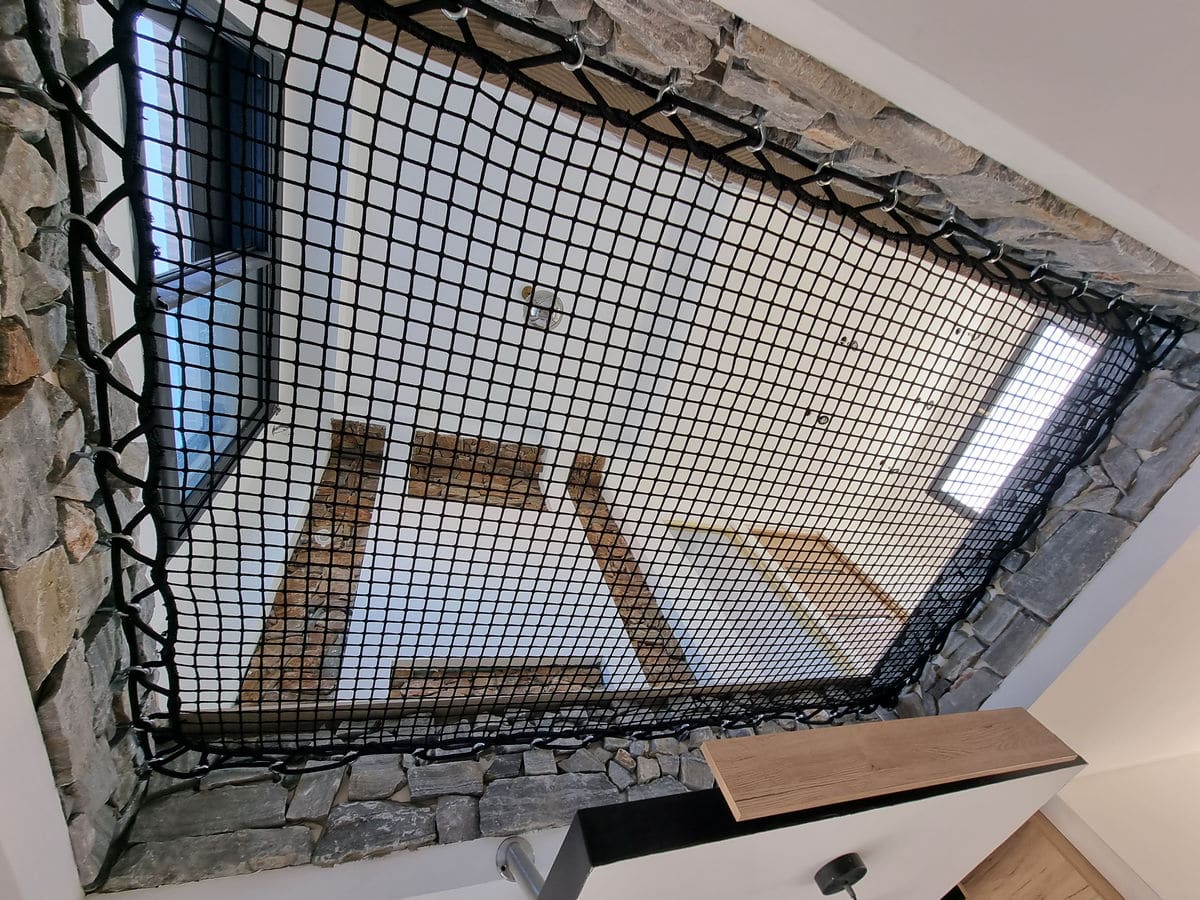
How much does custom-made mezzanine netting cost?
How much does a custom mezzanine net cost? This is often the first question people ask when considering how to convert a living room loft or make the most of high ceilings. The answer depends on your project, but let’s start with a rough estimate: a Feelnets mezzanine net starts at around 350 euros and typically ranges from 90 to 150 euros per square meter, including mountings and ropes, with delivery within France.
Three factors determine this price: the area to be covered, the mesh size you choose, and the fasteners suitable for your surface. Rather than an abstract price, here are examples of actual projects with cost breakdowns—which explain why prices vary from one project to another—and how to get an estimate for your own project. Since each net is custom-made, we’ll send you a personalized quote free of charge within 3 hours.
The price per square meter of a mezzanine netting
Rather than a theoretical price list, here are examples of projects actually produced by Feelnets, ranging from small nets to large ones, on various supports. Prices are listed inclusive of tax, fasteners, and cordage, with shipping within France included.
| Configuration | Price including tax, delivered | Price per square meter |
|---|---|---|
| Small net, 2.7 m² | €407 | €151/m² |
| 4.3 m² net on stainless steel cable | €607 | €142/m² |
| 5.6 m² net area on IPN | 579 € | €104/m² |
| Large net, 9.2 m² | 814 € | €88/m² |
One trend stands out: the larger the area, the lower the price per square meter. Prices range from about 150 euros per square meter for a small net to less than 90 for a large one. This makes sense: part of the cost is fixed regardless of size, so it has a greater impact on smaller areas. A large net costs more overall, but it works out to a better price per square meter.
Detailed Examples of Projects
Small net — 2.7 m²
€407 (including tax) — €151/m²
1.83 x 1.48 m opening, wood frame on all four sides. 44 crossbars on stainless steel plates, 30×30 white mesh, single-strand 10 mm rope lacing.
Net with one side without support — 4.3 m²
€607 (including tax) — €142/m²
2.25 x 1.90 m opening, wood framing on 3 sides and 5 mm stainless steel cable on the 4th. 43 black carabiners on stainless steel plates, 30×30 gray mesh, double lacing.
Net on a metal frame — 5.6 m²
€579 (including tax) — €104/m²
2.48 x 2.25 m opening, IPN frame on all four sides. 63 eye screws with stainless steel clamping bolts, 30×30 black mesh, double lacing.
Large net — 9.2 m²
€814 (including tax) — €88/m²
3.22 x 2.85 m opening, wood frame on all four sides. 81 galvanized steel bolts (8x80 mm), beige 30×30 mesh, double lacing.
Factors That Affect the Price of a Mezzanine Fillet
Beyond surface area—which remains the primary factor—three elements account for the price difference between projects: mesh, fasteners, and lacing. You can adjust these three factors to fit your budget.
The area
This is the number one factor, as shown in the table above. The total price rises with the number of square meters, but the cost per square meter actually decreases. A small net remains the most affordable option in absolute terms, while a large net offers the best value per square meter.
The knit
Feelnets offers two mesh sizes for indoor use. The 30×30 mm size, which is the most common, allows light to pass through. The 13×13 mm size, which is denser and heavier, provides a more closed surface. This density comes at a cost: for a 2 x 2 m net with identical mesh, fasteners, and cordage, switching from the 30×30 to the 13×13 option costs about 20% more. To find out which one to choose based on your intended use, check out our mesh guide.
The Fasteners
The choice of fasteners has a greater impact on the price than one might think. For the same 2 x 2-meter net, with only the fasteners changing—ranging from a simple zinc-plated steel piton to a stainless steel piton—the price increases by more than 25%.
| Mounting (identical 2x2 m net) | Price including tax, delivered | Price per square meter |
|---|---|---|
| Galvanized steel pins | €429 | 107 €/m² |
| Stainless Steel Plate Mounts | €498 | €124/m² |
| White stainless steel bridge plates | 508 € | €127/m² |
| White stainless steel pitons | 542 € | 136 €/m² |
Zinc-coated steel is the most economical option and is ideal for indoor use. Stainless steel, which is more expensive, is essential for outdoor use and is prized for its finish—particularly the white or black plate-mounted brackets, which blend seamlessly into the surroundings. Details on each fastener and its use can be found in our fastener guide.
Ropes and Lacing
The net is laced around its perimeter with a tension cord. Single lacing is sufficient for everyday use. Double lacing—which Feelnets recommends for heavy use, with children, or for rental purposes—doubles the length of the cord and therefore adds a few dozen euros to the cost of the project. It’s a small additional cost for enhanced durability over time.
What is included in the price of a Feelnets net?
The prices listed are all-inclusive, with no hidden charges when you place your order. Each net is delivered ready to install, with everything you need included.
Included in the price
- The net is custom-made to your exact specifications
- Mounts Suitable for Your Surface
- The tension cord
- The Installation Guide
- Shipping to mainland France
Not included
- Installation, which can be done by two people using a screwdriver = no additional cost
- Hiring a professional, if you'd rather have someone else handle it
Feelnets calculates the number of mounts and the length of the cord based on your setup, so you don’t have to figure anything out yourself. And if you’d like to have it installed, we can connect you with a partner contractor near you. To learn everything about installation, check out our installation guide.
Is installing a custom-made net less expensive than having the work done?
Considering what it offers, the mezzanine netting is a cost-effective solution. Creating a full slab or floor to make use of ceiling height requires structural work, a load-bearing structure, sometimes a building permit, and a bill running into the thousands of euros. The net, on the other hand, is stretched between your existing structures without touching the load-bearing walls, for just a few hundred euros.
For the price of a simple renovation, you gain a usable space where you can sleep, read, play, or relax, while preserving the room’s light and sense of space. This is often the fastest and most affordable way to gain usable square meters without expanding or adding walls.
Want to know the price of your net? Send us your measurements, and you’ll receive a detailed, free quote in less than 3 hours.
Do you have questions about your board or bindings? Our team is available by phone, email, or WhatsApp.
FAQ - Frequently Asked Questions About the Price of a Custom-Made Net
How much does custom-made mezzanine netting cost?
A Feelnets mezzanine net starts at around €350 and typically ranges from €90 to €150 per square meter, including fasteners and ropes, with delivery within France. The price depends on the surface area, mesh size, and fasteners. Since every project is unique, we’ll send you a personalized quote free of charge within 3 hours.
What is the price per square meter of a mezzanine netting?
The price decreases with size: expect to pay about €150 per square meter for a small net and less than €90 for a large one. Part of the cost is fixed regardless of size, so it represents a larger proportion of the total cost for smaller areas. A large net is more expensive overall, but more cost-effective per square meter.
Does the price include bindings and ropes?
Yes. The price of a Feelnets net is all-inclusive: the custom-made net, the fasteners suited to your mounting surface, the tensioning cord, the installation instructions, and delivery within mainland France. Only the installation is not included; most customers install it themselves with two people and a simple screwdriver.
Why does a custom-made net cost more than a standard net?
Because it is custom-made to fit your space exactly, with a mesh certified to EN 1263-1 and fasteners that fit your mounting surface perfectly. You’re paying for a net that fits perfectly and installs without any adjustments—not a standard product that needs to be cut to size. This guarantees a safe installation and a clean finish.
Is the 13×13 mesh more expensive than the 30×30?
Yes, slightly. With the same net, fasteners, and cordage, the 13×13 mm mesh costs about 20% more than the 30×30 mm mesh because it is denser and heavier. The choice depends mainly on the intended use, as detailed in our mesh guide.
Is there a charge for delivery?
Shipping is free throughout mainland France. For international shipments, shipping is insured and the cost is calculated based on the destination and included in your quote.
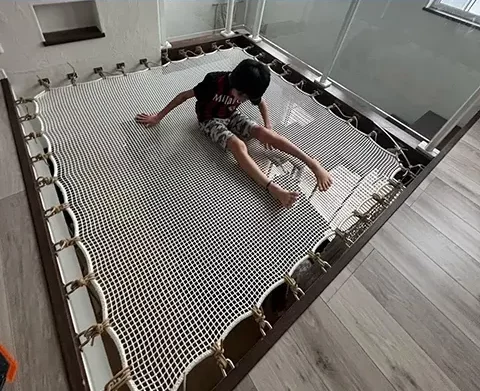
Loft Net, Hammock Floor, Trampoline Net: What's the Difference?
Short answer: they are often the same product sold under different names. A loft net (or mezzanine net) is a tensioned net installed horizontally to create a suspended floor, play space or reading area. A hammock floor is the same product, named for how it feels rather than what it does. A trampoline net is the marine original — the mesh deck stretched between the hulls of a catamaran — and the name followed the material indoors. A balustrade net is the one that is genuinely different: it is installed vertically, as a barrier rather than a surface.
If you are trying to describe what you want to an architect, a builder or a manufacturer, that distinction between horizontal surface and vertical barrier matters far more than which of the names you happen to use.
Why does one product have so many names?
Because it arrived from three directions at once.
Suspended mesh has been used at sea for decades, where it is called a trampoline. Architects began specifying similar mesh indoors and described it by its function — a mezzanine, a loft floor. Meanwhile homeowners who lay on one for the first time reached for the most obvious comparison available, and called it a hammock.
None of those names is wrong. They simply come from different worlds, and none of them has won. The result is a category where searching for one term hides half the market from you, and where two suppliers can quote for what sounds like different products and deliver the same thing.
What is a loft net?
A loft net, also called a mezzanine net, is a net tensioned horizontally across an open space — typically a void above a living room, a landing, or the open side of a mezzanine level.
It creates usable area where there was only air. People use loft nets as reading corners, play spaces, guest sleeping areas, and as a way to make a double-height room feel connected rather than divided. In tight footprints — tiny houses, converted attics, small apartments — it adds floor without adding structure.
The term is the most useful one to use with architects and builders, because it describes the architectural function rather than the sensation.
What is a hammock floor?
A hammock floor is a loft net. The term describes the experience: the slight give underfoot, the way the mesh takes the shape of whoever is lying on it.
It is worth knowing the term exists, because it is what many homeowners search for and what a lot of interior-design coverage uses. But it is a consumer word rather than a trade one. Ask a structural engineer for a hammock floor and you may get a puzzled look; ask for a tensioned mezzanine net and you will not.
One practical distinction: "hammock floor" is almost always used for indoor residential installations. Nobody calls a sports barrier or a hotel terrace net a hammock floor.
What is a trampoline net?
This is where the material originally comes from. On a catamaran or trimaran, the trampoline is the mesh deck stretched between the hulls — walked on, sat on, slept on, and exposed permanently to sun, salt and movement.
Those conditions produced a mesh that is strong, dimensionally stable, comfortable against skin and highly UV-resistant. When designers started looking for something to span an indoor void, marine trampoline mesh was already solving a harder version of the problem.
So "trampoline net" can mean two things: the actual deck on a multihull, or an indoor net made from the same marine-grade material. In a boating context it is precise. In an architectural context it tends to confuse, because most people hear it and picture a garden trampoline with springs — a completely unrelated product.
What is a balustrade or railing net?
This one is genuinely a different product, and the difference is orientation.
A balustrade net is installed vertically. It fills the gap in a stair rail, a landing edge or a mezzanine guard, functioning as an infill panel rather than a surface. Nobody sits on it. Its job is to stop things — usually children, pets, or objects — passing through a gap.
Because it is a barrier rather than a floor, the design priorities change. Mesh aperture matters more than comfort. It is also the net most likely to interact with building regulations, since it is doing the work a guard or balustrade would otherwise do.
Confusing the two is the most consequential naming error in the category, and it happens often. A net specified as a floor and a net specified as a barrier are not interchangeable.
Horizontal or vertical: the distinction that actually matters
| Name | Orientation | Typical use | What it is for |
|---|---|---|---|
| Loft net / mezzanine net | Horizontal | Voids, mezzanines, landings | A surface to occupy |
| Hammock floor | Horizontal | Residential interiors | A surface to occupy |
| Trampoline net (marine) | Horizontal | Between catamaran hulls | A deck to move on |
| Trampoline net (interior) | Horizontal | Indoor voids | A surface to occupy |
| Balustrade / railing net | Vertical | Stair rails, guards, mezzanine edges | A barrier to stop passage |
| Terrace and balcony net | Either | Outdoor living space | Surface or barrier |
| Sports and golf netting | Vertical | Pitches, ranges, courts | Containment |
Everything above the balustrade row is a surface. Everything from it down is either a barrier or containment. Get that right and the vocabulary sorts itself out.

Which term should you use?
Talking to an architect, builder or engineer: use mezzanine net or tensioned net, and say horizontal or vertical explicitly. These are functional terms that map onto how they think about a building.
Searching online: try several. Loft net, hammock floor and mezzanine net surface noticeably different results, and you will otherwise miss suppliers who use the other word.
Requesting a quote: the name matters less than four pieces of information — orientation, the dimensions of the opening, what the net will be fixed to, and who will use it. Any manufacturer worth dealing with will ask for those regardless of what you called it.
Talking about boats: trampoline is correct and unambiguous. Use it.
Frequently asked questions
Is a hammock floor the same as a loft net? Yes. Same product, different name — one describes the feel, the other the function.
Can you walk on a loft net? Yes, though it flexes underfoot and takes a moment to get used to. Suitability depends on the specification, so confirm intended use with your manufacturer before ordering.
Is an indoor net the same as a garden trampoline? No. A garden trampoline uses springs and a solid frame to bounce. An interior net is a tensioned mesh surface with no spring system.
What is the difference between a balustrade net and a loft net? Orientation and purpose. A balustrade net is vertical and acts as a barrier; a loft net is horizontal and acts as a surface.
Can the same mesh be used indoors and outdoors? Marine-grade polyester mesh is designed for permanent UV and salt exposure, so it performs indoors and out. Cheaper fibres often do not survive sustained sunlight.
What should I send a manufacturer to get a quote? Orientation, opening dimensions, a photo of the space, what the fixings will go into, and how the net will be used.
Feelnets has manufactured made-to-measure nets in Quimperlé, France since 2012, for homes, hotels and multihulls worldwide. If you are unsure which product fits your space, send us your dimensions and a photo and we will tell you what you need.
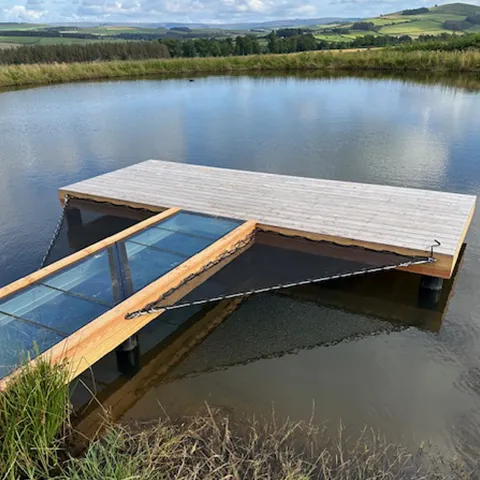
Dock & Waterfront Netting: The Missing Piece for Lake Houses and Cottage Living
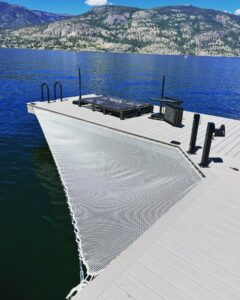
There's a particular kind of property where a deck, a dock, and open water all meet — and where the space in between is usually wasted. Lake houses, cottages, and waterfront resorts pour money into the dock itself and the shoreline landscaping, but the zone that connects them is often left as bare boards or, worse, empty air over the water. That's exactly the space a custom dock net is built to claim.
What Is Dock Netting, Exactly?
Dock netting is a marine-grade net suspended between dock posts, pilings, or a dedicated frame, creating a stable surface — or a soft, hammock-like one — directly over the water. Depending on how it's installed, it can serve two very different purposes: a taut, walkable net that turns unused space beside or beneath a dock into a lounging platform, or a looser, cradle-style net designed purely for relaxing above the water's surface.
Feelnets builds both versions to measure, using the same marine-grade mesh developed for our catamaran trampoline nets — material that's already proven itself against sun, salt, and constant moisture on boats sailed year-round.
Why It's the Upgrade Most Waterfront Properties Are Missing
1. It Turns Dead Space Into the Best Seat on the Property
The stretch of water beside a dock, under a boathouse, or off the end of a pier is rarely used for anything. A net installed there becomes the spot everyone ends up — close enough to the water to dangle a hand in it, comfortable enough to stay for hours. It's usable square footage that doesn't require a single extra board of decking.
2. It Adds a Real Safety Barrier
For families with young children or pets, open water at the edge of a dock is a constant, low-level worry. A properly tensioned net around a swim platform or between dock sections acts as a physical barrier without blocking the view or the breeze — a very different solution from a rigid rail, and one that suits the relaxed character of a lake property.
3. It's a Signature Feature for Rental and Resort Properties
For cottage owners renting on Airbnb or VRBO, and for lakeside or coastal resorts competing for bookings, a net suspended over the water is the kind of feature that photographs itself. It reads as considered, high-end design rather than standard dock furniture — the same effect Feelnets nets have already created for boutique hotels working with overwater and terrace installations.
4. It's Engineered for Water, Not Just Weather
A garden hammock or a generic outdoor net isn't built for constant proximity to water — freshwater algae, fluctuating humidity, and in coastal settings, salt spray all shorten the life of ordinary materials fast. Dock netting needs the same resistance profile as marine rigging: UV-stabilized, rot-proof, and tensioned to handle the movement of a structure that's partially over water.
5. It Complements Everything Already on the Water
Unlike a deck extension or a permanent structure, a net installation works with an existing dock rather than requiring you to rebuild it. It can be fitted around ladders, cleats, and boat slips, and it's just as suited to a quiet freshwater lake dock as it is to a busy coastal marina frontage.
Built for the Property, Not Off a Shelf
Every dock is different — different piling spacing, different heights above the waterline, different exposure to wind and current. That's precisely why standard, pre-cut netting rarely fits well over water. A made-to-measure net, sized and tensioned for the specific structure it's attached to, is what actually holds up season after season.
Feelnets has spent over a decade making marine-grade nets for boats sailed in open water worldwide — the same expertise now shapes our dock and waterfront netting for homes, cottages, and resorts.
Dock & Waterfront Netting Contact us to receive a custom quote
Receive your quote in less than 3 hours! Request your Free Quote
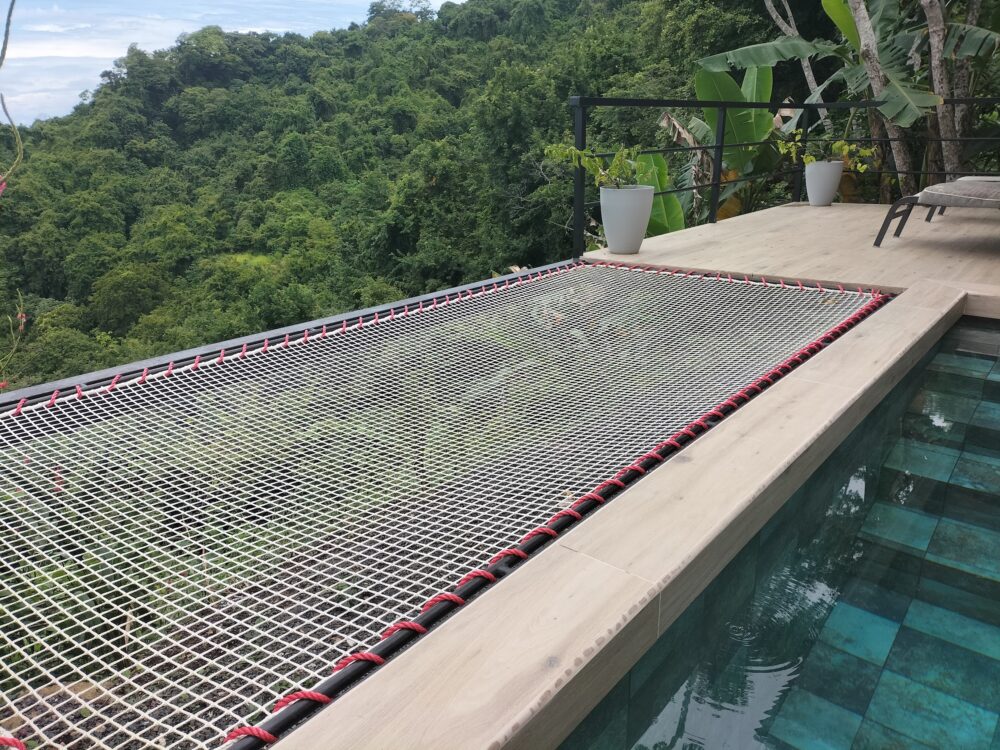
Stargazer Net Beds: Why Suspended Loungers Are the Next Big Thing in Boutique Hospitality
A few years ago, the feature guests photographed most at a boutique hotel was the pool. Today, it's increasingly likely to be a net — suspended over a cliff edge, a pool deck, or the open air between two trees, with nothing but woven mesh and open sky between the guest and the view. The stargazer net bed has quietly become one of the most shared, most requested features in high-end hospitality design, and it's a natural next step for any property that has already discovered what a suspended net can do for a terrace or lounge area.
What Is a Stargazer Net Bed?
A stargazer net bed is a custom-made net installed specifically for lying down and looking up — typically positioned over a dramatic view, a pool, water, or open landscape, and often built with a slight cradle shape rather than a flat tension for extra comfort. Unlike a hammock, it holds multiple guests at once, is open on all sides, and disappears visually into its surroundings rather than dominating them. Positioned well, it turns an ordinary evening into the kind of moment a guest remembers the stay by.
Feelnets designs these to measure, using the same UV- and weather-resistant marine mesh developed for our catamaran and outdoor nets, engineered to stay comfortable and safe under constant sun and night exposure.
Why It's Resonating With Hospitality Design Right Now
It Matches Where Hospitality Design Is Heading
2026's hospitality trends are leaning hard into multisensory, experience-first design — spaces built around how a guest feels, not just how a room looks on a floor plan. A net bed delivers exactly that: the sensation of floating, the sound of the wind, an unobstructed view of the sky. It's a feature no amount of furniture can replicate.
It's Inherently, Effortlessly Photogenic
Unlike a lot of hotel amenities, a net bed doesn't need styling to look extraordinary — golden hour light through a suspended mesh, a couple lying beneath the stars, a single lounger cantilevered over a pool. It's the kind of image that gets shared without being asked to be shared, generating the organic visibility that hospitality marketing teams pay agencies to manufacture.
It Works in Places Nothing Else Can
A rooftop, a cliffside terrace, the space above a pool, the gap between two trees on a resort's grounds — a lot of the most dramatic real estate at a property is unusable by conventional furniture. A tensioned net can be installed almost anywhere there are two solid anchor points, turning previously "dead" or purely scenic space into a bookable experience.
It Signals a Property Has Been Designed, Not Just Decorated
The properties earning attention in 2026 are the ones treating design as storytelling — distinctive, site-specific features rather than generic luxury signifiers. A net bed built for one exact location, one exact view, can't be replicated at the property down the road. That specificity is precisely what differentiates a design feature from a design cliché.
It's a Lower-Cost, Faster Build Than It Looks
Compared to a permanent structure — a gazebo, an overwater bungalow extension, a built-in daybed — a custom net installation is comparatively fast to install and doesn't require the same structural investment. For hotels and resorts moving quickly on a seasonal refresh or a single standout feature, it's an outsized visual impact for a contained project.
Designed Around the View, Not the Other Way Around
The best stargazer net beds aren't off-the-shelf products bolted onto a random corner of a property — they're designed around a specific view, a specific structure, and the exact way a hotel wants a guest to experience that moment. That's a made-to-measure problem, not a catalog one.
Feelnets works with hotels and resorts worldwide to design nets built for their exact setting, from the mesh color and mounting hardware to the shape of the net itself.
Stargazer Net Beds Contact us to receive a custom quote
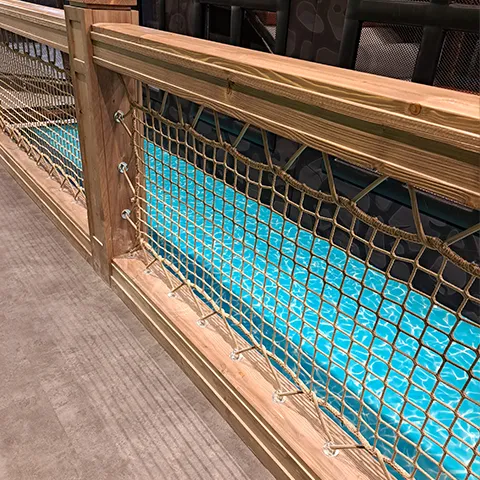
Net vs. Glass Balustrade: Cost, Safety, and Design Comparison
When it comes to securing a staircase, mezzanine, or balcony, glass balustrades have long been the default choice for homeowners and architects seeking a modern, open look. But a growing number of design-conscious homeowners are choosing a different solution: custom-made rope and net balustrades.
Both options can meet safety requirements and create a clean, contemporary look — but they differ significantly in cost, maintenance, design flexibility, and feel. Here's how they compare, so you can choose the right solution for your project.
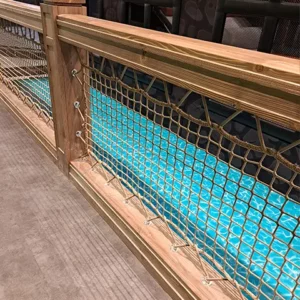
Safety: Two Different Approaches, Similar Protection
Glass balustrades work by creating a rigid, transparent barrier. They're strong, stable, and, when installed correctly with tempered or laminated safety glass, meet building safety standards for fall protection.
Net balustrades work differently: rather than a rigid barrier, a tensioned mesh of rope or cord absorbs impact and flexes slightly under pressure, while still preventing falls. This makes net balustrades a particularly popular choice for households with young children, since the mesh eliminates the hard edges and impact risk that glass panels can present. Unlike glass, a net balustrade also can't shatter, which some homeowners see as an added peace of mind, particularly in high-traffic family homes.
Both solutions, when properly designed and installed by professionals, provide reliable protection for stairs, mezzanines, and balconies. The right choice comes down to which type of protection best suits your household and design goals.
Design and Visual Impact
This is where the two options diverge most. Glass balustrades offer a minimalist, fully transparent look that lets light pass through uninterrupted — a popular choice in contemporary architecture where visual openness is a priority.
Net balustrades, by contrast, introduce texture, warmth, and a distinct architectural character that glass simply can't replicate. A rope balustrade on a designer staircase, for example, adds a tactile, almost nautical or organic quality to a space, and can be customized in a range of colors and mesh sizes to complement any interior style — from rustic and industrial to refined and minimalist.
For homeowners looking to make a design statement rather than simply meet code requirements, a custom net balustrade often stands out precisely because it's less commonly seen than glass — and because every net is made to measure for the specific staircase or mezzanine, rather than cut from standard panel sizes.
Cost Considerations
Glass balustrades typically involve higher material and installation costs, particularly for tempered safety glass, custom cuts around curved staircases, and the metal framing required to hold panels securely in place. Glass is also heavier, which can add structural requirements and installation complexity, especially in renovation projects.
Net balustrades are generally more cost-effective, both in materials and installation. Because the netting is lightweight, tensioned, and fitted using straightforward fastening systems, installation is typically faster and less invasive — an important advantage for renovation projects where minimizing structural work matters.
Maintenance and Durability
Glass requires regular cleaning to stay looking its best, as fingerprints, smudges, and water spots show easily on a transparent surface. It's also, despite being "safety glass," susceptible to chipping or cracking from impact over time.
A well-made net balustrade, particularly one manufactured from high-performance polyester mesh, is designed to resist UV exposure, moisture, and daily wear with minimal upkeep. There's no glass to clean or risk of shattering, making it a practical option for busy households or properties where low-maintenance materials are a priority.
Which Should You Choose?
- Choose glass if your priority is maximum transparency, a strictly minimalist look, and you're comfortable with higher upfront cost and ongoing cleaning.
- Choose a net balustrade if you want a distinctive, textured design feature, added flexibility for households with children, lower installation complexity, and a more cost-effective solution that's easy to maintain.
Ultimately, both options can deliver a safe, code-compliant staircase or mezzanine railing — the decision comes down to the look, feel, and practicality you want for your home.
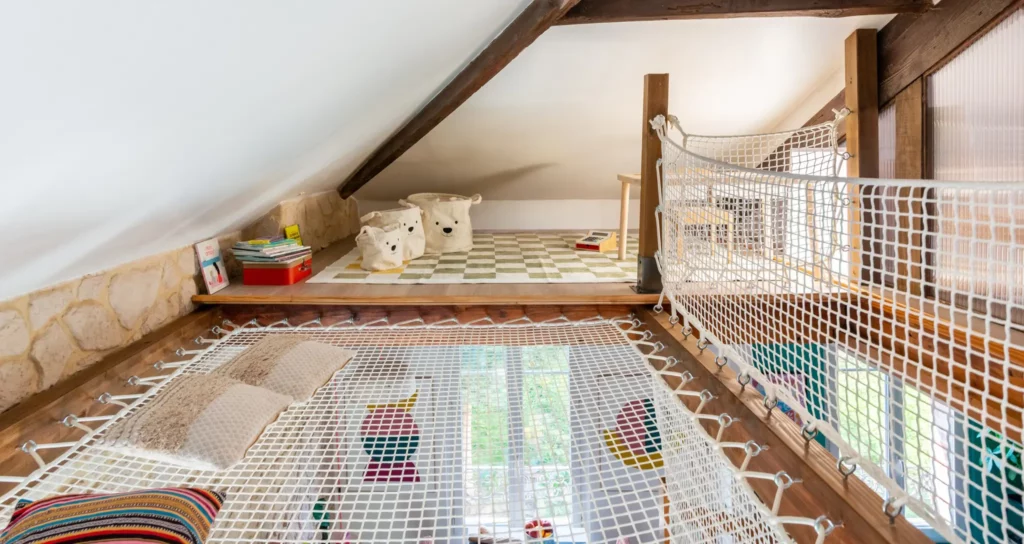
Custom-Made Net Balustrades, Designed for Your Staircase
At Feelnets, every balustrade net is made in France to the exact dimensions of your staircase, mezzanine, or balcony, with a choice of mesh sizes, rope colors, and finishes to match your interior. Our team handles the project from design through to delivery, with a personalized quote provided in under three hours.
Considering a net balustrade for your home? Get your free, personalized quote today and discover how a custom net can transform your staircase or mezzanine.
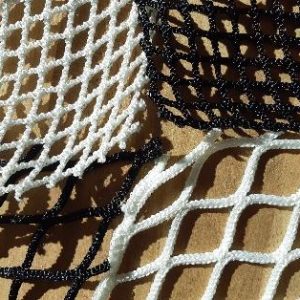
What mesh size should you choose for your custom-made net?
Choosing the right mesh is the first step in selecting your net. It determines safety, visual appeal, comfort, and suitability for your project. Feelnets offers several types of mesh, each designed for specific configurations and uses.
This guide helps you understand the differences, identify the right mesh for your situation, and avoid the most common mistakes.
Quick Comparison of Feelnets Meshes
All Feelnets nets are custom-made in France, EN1263-1 certified, and delivered with the fasteners suited to your structure, as detailed in our fastener and lacing guide. The choice of mesh depends on your project, your safety requirements, and the desired aesthetic. Our teams of experts are here to assist you every step of the way in creating your net.
Catamaran nets and sailing trampolines must meet specific requirements: materials, tension, and saltwater resistance. We’ve put together a comprehensive guide dedicated to catamaran net mesh to help you make the right choice.
| Knit | Material | Installation | Color | Durability |
|---|---|---|---|---|
| 30×30 mm | Polyester 3+ | Horizontal & vertical | 200 kg/m² | |
| 13×13 mm | Polyester 3+ | Horizontal only | 200 kg/m² | |
| 48×48 mm | Polyamide | Vertical only | - | |
PVC Mesh by Serge Ferrari |
Technical PVC | Horizontal | Depending on the range | - |
30×30 mm and 13×13 mm mesh sizes are our standard options, available for all projects. The 48×48 mm polyamide mesh is offered as an option for railings. Serge Ferrari PVC mesh is available for projects with high aesthetic standards.
- 30×30 mm: the most versatile option, for both indoor and outdoor use, suitable for all projects
- 13×13 mm: safety first, young children, maximum retention
- 48×48 mm: railings only, understated and transparent
- PVC Mesh: premium projects, high-end patios, or the hospitality industry
Still not sure? Contact our team of experts—we’ll help you choose the right mesh for your project.
Feelnets Mesh in Detail
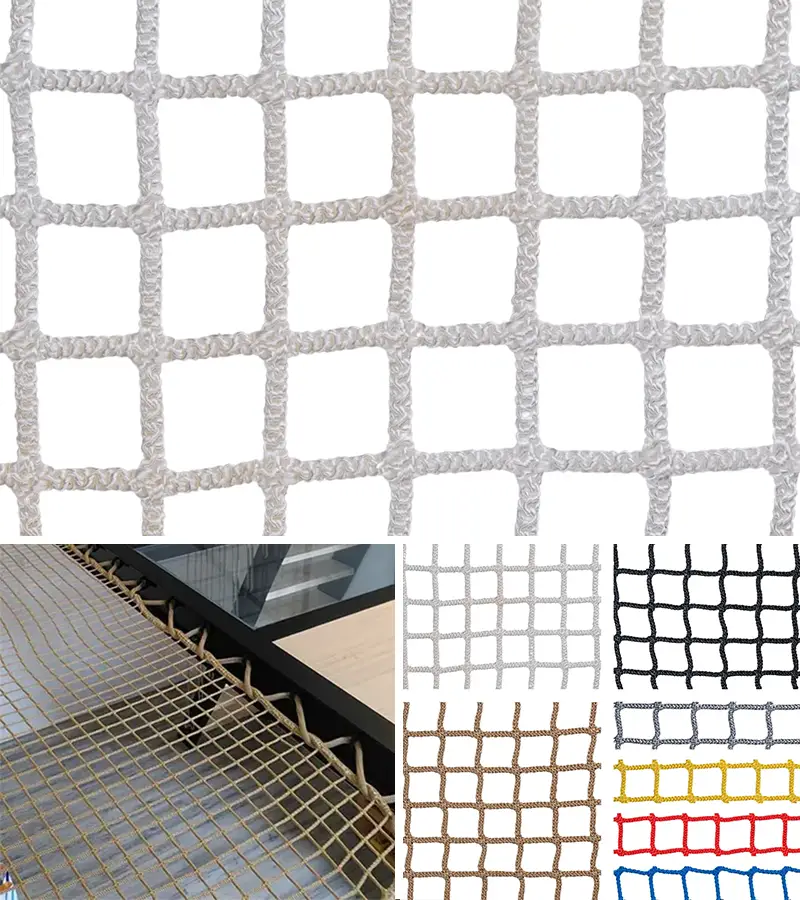
30×30 mm mesh — 3+ polyester
A versatile mesh for all indoor and outdoor projects.
Ideal uses
- Horizontal mezzanine net
- Railings: stairs, stairwell, balcony
- Outdoor area: patio, pergola
- Suspended relaxation area
Colors
Benefits
- Load-bearing capacity: 200 kg/m², certified to EN 1263-1
- UV-resistant and water-resistant
- Good transparency, lets light through
- Soft to the touch, comfortable to walk on barefoot
- Horizontal and vertical installation
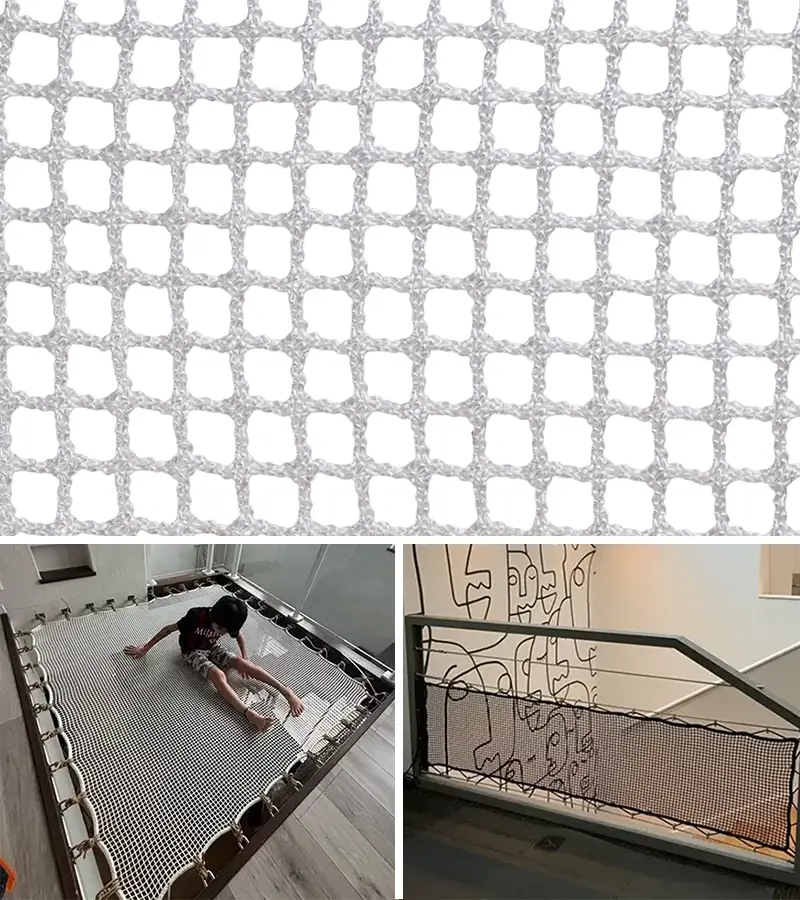
13×13 mm mesh — 3+ polyester
Close-knit fabric, for projects where the safety of young children is a top priority.
Ideal uses
- Mezzanine with young children
- Hopper or floor opening to be secured
- Any project with maximum retention
- For indoor and outdoor use
Colors
Benefits
- Swallowing small objects and toys
- Load-bearing capacity: 200 kg/m², certified to EN 1263-1
- Reduces dizziness
- Excellent barefoot comfort
- UV-resistant and water-resistant
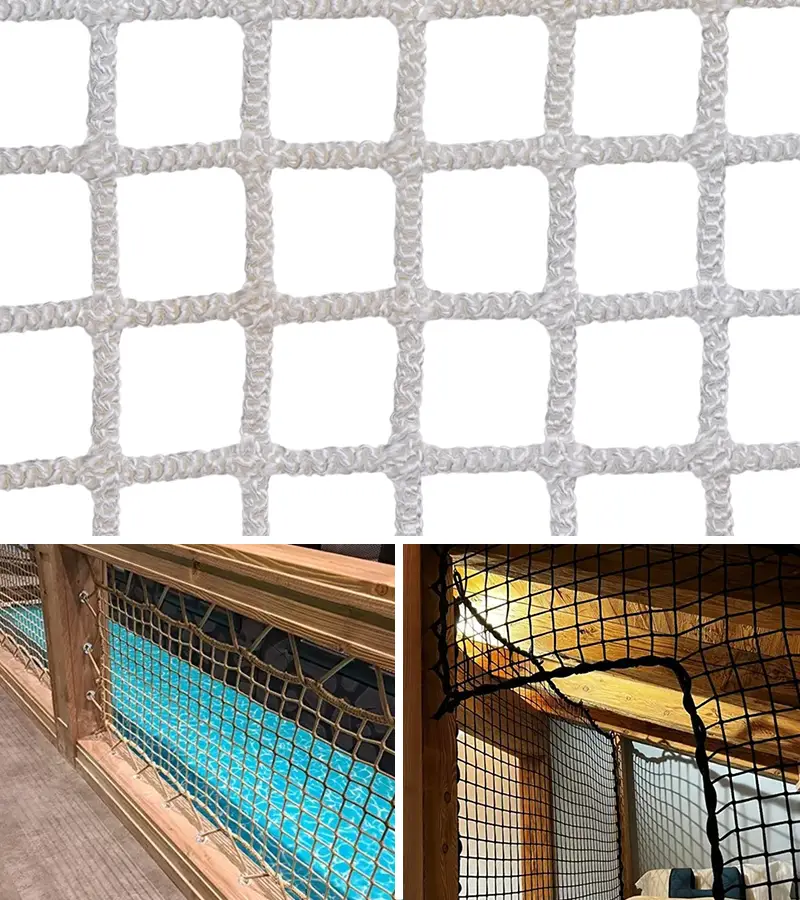
48×48 mm mesh — Polyamide
The discreet choice for railings, when transparency and aesthetics are key.
Ideal uses
- Stair or mezzanine railing
- Balcony or patio railing
- Decorative indoor fencing
- For vertical installation only
Colors
Benefits
- Maximum transparency
- Optimal light transmission
- Clean, understated look
- Slightly stretchy, soft to the touch
- Available in 3 colors
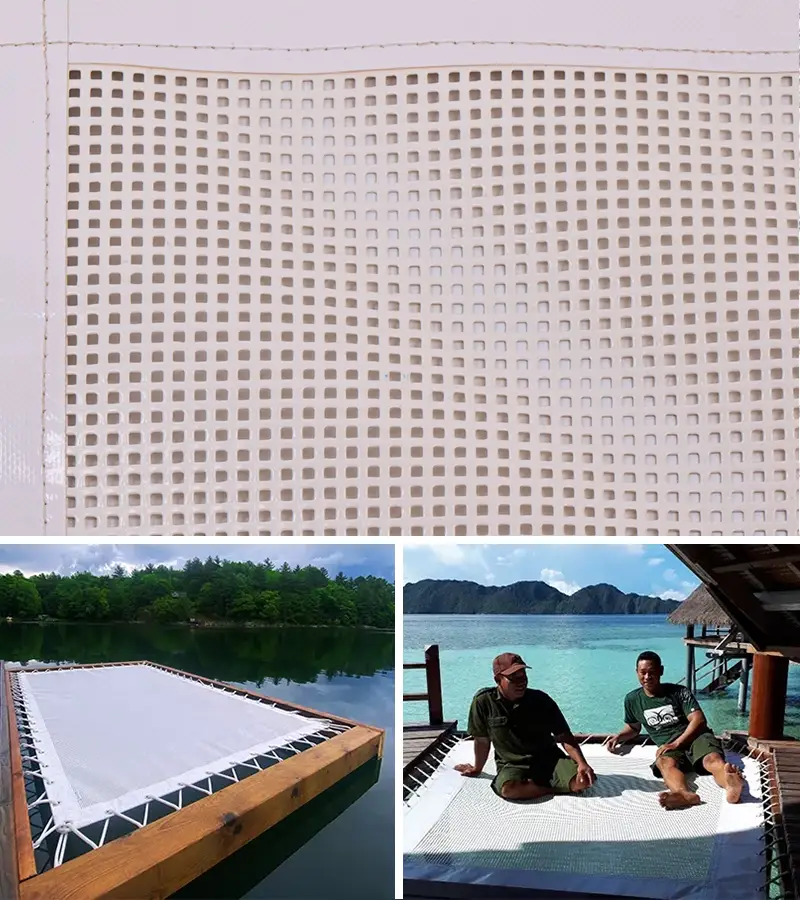
Serge Ferrari PVC Mesh
High-end technical fabric for projects with a strong architectural focus.
Ideal uses
- Mezzanine with a striking architectural design
- Terrace, rooftop, lounge area
- Hotel projects or event spaces
- Indoors and outdoors
Colors
Depending on the Serge Ferrari collection, upon request
Benefits
- Premium material, inspired by the nautical world
- Excellent UV and weather resistance
- Smooth surface, refined finish
- Very easy to maintain
- Fire-resistant properties in accordance with standards
Which gauge is right for your project? Find the right setup at a glance
Every project has its own constraints: intended use, safety, and aesthetics. Here are the most common configurations and the mesh size Feelnets recommends for each.
Versatile mezzanine
Recommended mesh size: 30×30 mm, 3+ polyester
Ideal for hard surfaces, lightweight, and available in 7 colors.
Mezzanine with young children
Recommended mesh size: 13×13 mm, 3+ polyester
Close weave, traps small objects, reduces the sensation of dizziness.
Railings and Stairs
Recommended mesh size: 30×30 mm or 48×48 mm Polyamide
30×30 for a stylish look, 48×48 for maximum transparency and a discreet appearance.
Patio and outdoor area
Recommended mesh size: 30×30 or 13×13 mm, 3+ polyester
Built-in UV protection, weather-resistant, variety of colors, very low-maintenance
Suspended relaxation area
Recommended mesh size: 30×30 mm, 3+ polyester
Soft to the touch, comfortable to walk on barefoot, lightweight, and perfect for a hanging net in the living room or attic.
Premium Projects and Hospitality
Recommended mesh: PVC Mesh by Serge Ferrari
Smooth surface, refined architectural finish, extremely durable, available upon request.
Special meshes and custom manufacturing
In addition to our standard mesh sizes, Feelnets also manufactures nets with custom mesh sizes for technical or sports applications. These mesh sizes are available upon request, depending on the requirements of your project.
- Sports nets: mesh suitable for indoor and outdoor sports equipment (courts, multipurpose halls, nets, goals)
- Paddle tennis net: mesh and cordage conform to regulation dimensions
- Golf netting: technical mesh for safety and training nets
- Catamaran net : Dyneema mesh, an ultra-lightweight, high-strength material for catamaran trampolines
Do you know what mesh you need? Get your personalized quote in less than 3 hours.
Would you rather talk it over before you get started? Our team is available by phone, email, or WhatsApp.
FAQ - Frequently Asked Questions About Choosing the Right Mesh
Which mesh to choose for a mezzanine net?
The 30×30 mm Polyester 3+ mesh is the best choice in most cases: lightweight, versatile, and available in 7 colors, it is suitable for both play areas and suspended relaxation spaces. If young children are playing nearby, the 13×13 mm mesh is preferable due to its tighter weave and ability to retain small objects.
What is the difference between 30×30 mm mesh and 13×13 mm mesh?
Both mesh types are made from the same Polyester 3+ material, with the same strength (200 kg/m²) and the same EN 1263-1 certification. The difference is both visual and functional: the 30×30 mm mesh lets in more light, blends more discreetly into an interior, and is available in 7 colors. The 13×13 mm mesh is denser, catches small objects, and reduces the sensation of vertigo: it is recommended for projects involving young children or when a slight opacity is desired. It is available in white and black only.
What mesh size should I use for a net when playing with young children?
The 13×13 mm Polyester 3+ mesh is the standard choice for projects involving young children. Its tight weave prevents small objects and toys from falling through and reduces the sensation of vertigo. It is EN1263-1 certified and manufactured to the exact dimensions of your configuration.
Is the 48×48 mm polyamide mesh suitable for horizontal installation?
No. The 48×48 mm polyamide mesh is designed exclusively for vertical installation: guardrails, stair railings, balconies. Its mesh opening is too large for a horizontal walking surface. For a mezzanine or floor netting, 30×30 mm or 13×13 mm Polyester 3+ mesh are the only suitable options.
What mesh size should I use for an outdoor patio or balcony net?
Several Feelnets mesh products are suitable for outdoor use, each with its own advantages.
The 30×30 mm Polyester 3+ mesh is the most popular choice: it is designed to withstand the elements and sunlight without deteriorating, and is available in 7 colors. The 13×13 mm Polyester 3+ mesh is also well-suited for outdoor use; its tighter weave provides comfort and a pleasant feel, making it ideal for a patio or relaxation area. For a terrace or balcony railing, the 48×48 mm Polyamide mesh is an option if transparency and discretion are priorities, although it is less weather-resistant than the Polyester meshes. For high-end projects (rooftops, architectural terraces), Serge Ferrari PVC Mesh offers a premium finish and extreme resistance to outdoor conditions.
What is Serge Ferrari PVC Mesh, and what is it used for?
Serge Ferrari PVC Mesh is a high-end technical fabric derived from the nautical and architectural sectors. Unlike woven polyester mesh, it features a smooth, semi-rigid, knot-free surface. Feelnets offers it in two variants (392 and 492) for projects with a strong aesthetic focus: architectural mezzanines, premium terraces, hotel spaces, or reception areas.
Are Feelnets nets certified to EN 1263-1?
Yes. Both the 30×30 mm and 13×13 mm Polyester 3+ mesh panels are certified to EN 1263-1, the European standard for safety nets. This certification guarantees load-bearing capacity, edge strength, and the reliability of the fastenings. All Feelnets are designed and tested in France in accordance with this standard.
Can you choose the color of your knitwear?
Yes. The 30×30 mm Polyester 3+ mesh is available in 7 colors: white, beige, gray, black, red, yellow, and blue. The 13×13 mm mesh is available in white and black only. The 48×48 mm polyamide mesh is available in white, beige, and black. For Serge Ferrari PVC Mesh, the available colors depend on the selected range (392 or 492); please contact us for more details on this premium material.
What mesh size is best for a catamaran net or other marine applications?
Catamaran nets and marine applications are subject to specific requirements (saltwater resistance, light weight, constant tension) that call for specialized mesh, particularly Dyneema mesh. This topic is covered in a dedicated guide: see our guide to mesh for catamaran and multihull nets.
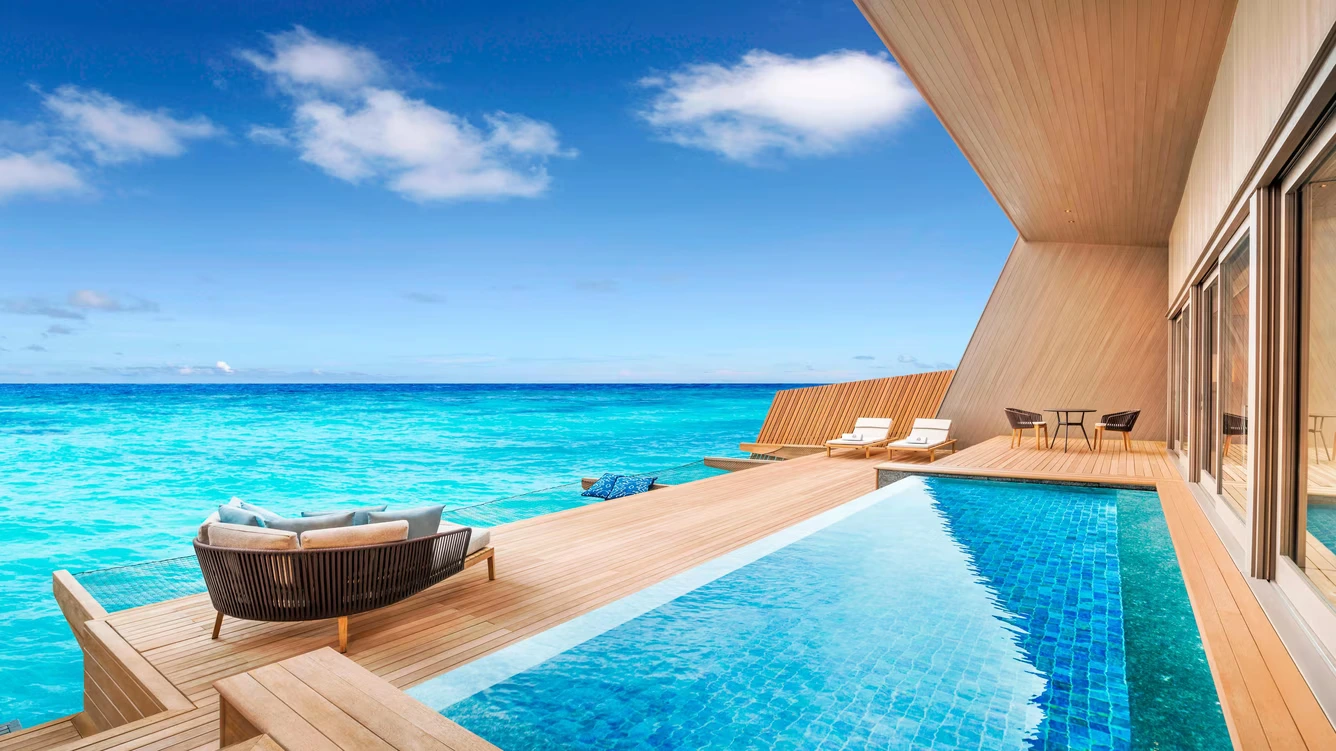
Custom Nets as a Hotel Design Feature (and Why Guests Love It)
There is a moment — familiar to anyone who has stayed in the right hotel — when you walk into a room or step onto a terrace and immediately want to take a photograph. Not of the view. Of the space itself.
Increasingly, that moment is created by a net.
From Function to Signature
Custom nets have been part of the hospitality industry for decades, primarily as safety features: barriers on elevated terraces, pool perimeters, or open-sided bungalows. What has shifted dramatically in recent years is the role design plays in how they are specified.
Where a generic railing once closed off a terrace, a tensioned net now opens it up. Where a balcony once needed a visual barrier, a fine-mesh installation now frames the horizon without interrupting it. The net has moved from afterthought to architectural signature.
More than 200 hotels worldwide have now partnered with Feelnets to bring this approach into their spaces — from boutique properties in the French Alps to overwater bungalows in the Maldives.
The Sunbed Net: A Category of Its Own
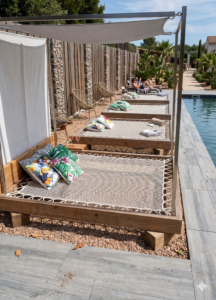
The most distinctive evolution in hospitality net design is the integrated sunbed net: a tensioned mesh surface suspended within a frame at terrace or deck level, replacing the traditional sun lounger with something far more immersive.
Guests don't sit on it — they sink into it. The mesh conforms to the body, allows airflow from below, and creates a sensation that no cushioned furniture can replicate. Photographed from above, it has become one of the most shared hotel images on social media.
For hotels, the value is compounded. A sunbed net is virtually maintenance-free compared to upholstered outdoor furniture: no fabric to replace, no cushions to store seasonally, no mold risk. The initial investment pays for itself over multiple seasons.
Designing for Atmosphere, Not Just Function
The most successful hotel net installations share one quality: they were designed for the experience they create, not merely the problem they solve.
Color selection matters enormously at this scale. White nets photograph beautifully against blue water and sky — which is why they dominate coastal and island properties. Beige and ecru integrate into warm stone or timber environments without drawing attention to themselves. For rooftop installations in urban settings, darker tones create a sophisticated tension against the skyline.
Mesh size shapes the experience too. Finer meshes feel refined and almost textile-like, appropriate for luxury interiors. Larger meshes introduce a more raw, architectural quality suited to design hotels and contemporary resort spaces.
What Guests Actually Say
Guest feedback on net installations clusters around three themes: comfort, novelty, and the feeling of connection to the surrounding environment. The absence of solid barriers — walls, railings, opaque panels — creates a psychological openness that guests consistently describe as relaxing.
The social dimension is equally real. Shared sunbed nets designed for two create an intimacy that standard side-by-side loungers do not. In hotel photography and on social platforms, they generate organic content that no marketing budget can easily replicate.
A Practical Note for Hospitality Buyers
Custom nets a hotel design feature involve a few specific considerations beyond residential installations. Surface areas are typically larger, requiring precise structural assessment of anchor points. Specifications must account for continuous daily use rather than occasional residential load. And lead times should be planned into renovation or opening schedules early.
Feelnets works directly with hotel architects, interior designers, and project managers — providing technical drawings, material samples, and on-site guidance where needed. The result is an installation built to the property's exact requirements, not adapted from a standard product.
In hospitality, details create loyalty. A net that makes a guest stop, sit down, and never want to leave is one of the most cost-effective investments a property can make.
Contact us to discuss your Custom Hotel Design Feature
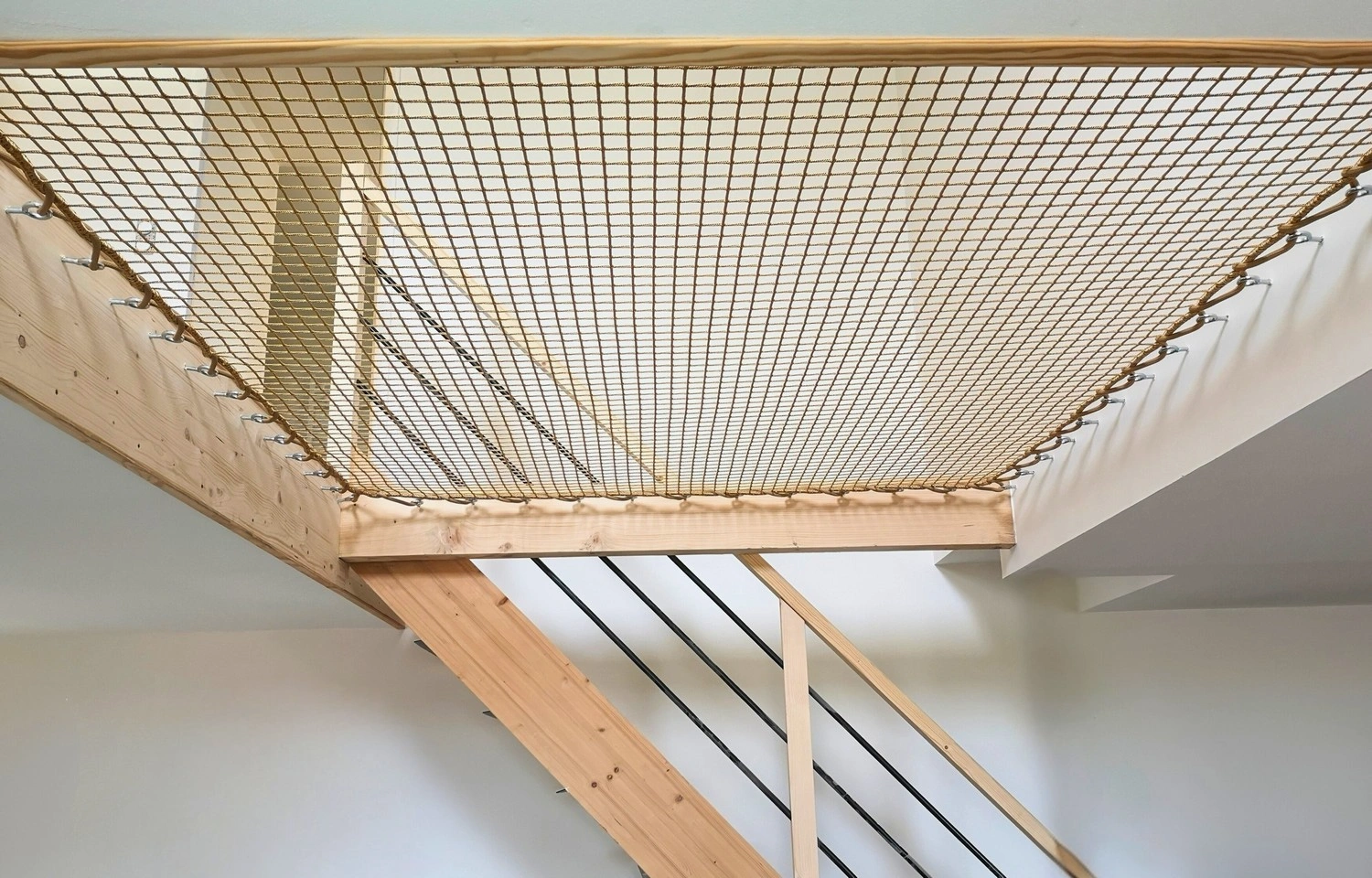
A Complete Safety & Style Guide to Choose your Mezzanine Net
Installing a net on your mezzanine is one of the smartest decisions you can make — for safety, for aesthetics, and for making the most of your vertical space. But with so many options available, the question quickly becomes: which net is actually right for my project?
This guide walks you through every variable that matters, so you can make a confident, informed choice.
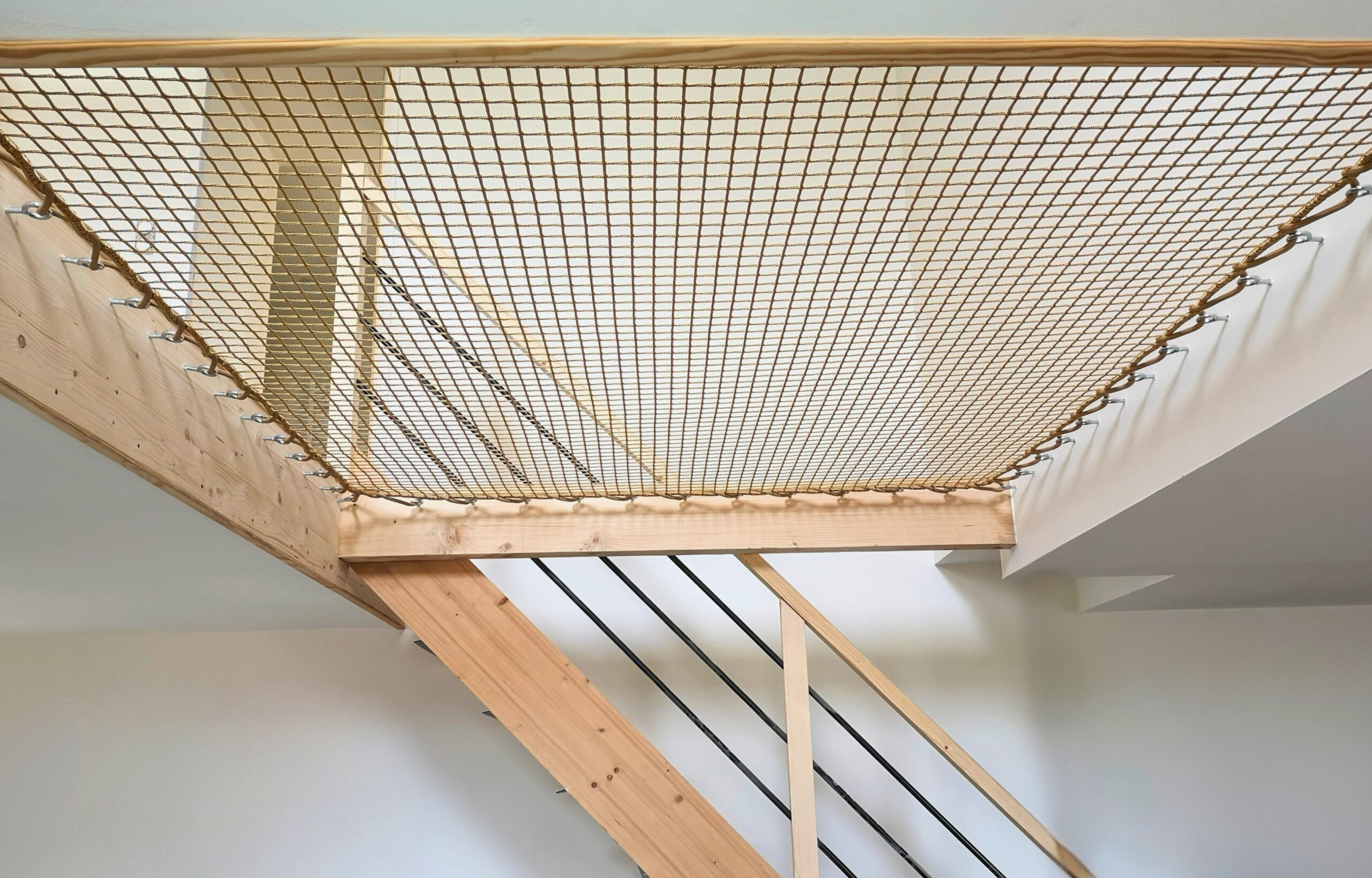
Why a Mezzanine Net Is More Than a Safety Feature
The obvious reason to install a mezzanine net is to prevent falls — especially in homes with children, pets, or open sleeping lofts. But today's custom nets go far beyond basic protection. They define the visual character of a space, letting light flow freely while creating a sense of openness that a glass balustrade or wooden railing simply can't match.
A well-chosen net turns a structural necessity into a design statement.
Choosing the Right Mesh Size
Mesh size is the first decision to make, and it depends on who uses the space and how.
30×30 mm mesh is the most popular choice for residential mezzanines. It offers excellent visibility from above, allows light to pass through, and is rated for standard domestic use. It's ideal for adult-only lofts, reading nooks, and open-plan living rooms.
20×20 mm mesh provides tighter protection and is recommended wherever children or small pets are present. The smaller openings significantly reduce the risk of limbs or heads passing through.
45×45 mm or larger mesh suits decorative installations where safety requirements are lower — think atmospheric overhead netting, artistic room dividers, or large-scale lounge furniture.
When in doubt, go smaller. You can always choose a finer mesh for aesthetic reasons; you cannot retrofit safety.
Load Capacity: What Will the Net Actually Bear?
This is where many buyers underestimate their needs. A mezzanine net used purely as a guard rail has very different requirements than one designed as a suspended lounging platform — a trend that has exploded in contemporary interior architecture.
For passive safety (preventing falls), a net tensioned along the perimeter is sufficient. For active use — sitting, lying, children playing — the net must be specified for load-bearing, with reinforced borders, appropriate rope diameter, and certified fixation points anchored into the structure. Always ask your manufacturer for load-bearing specifications in writing.
Color and Material: Blending with Your Interior
Feelnets' proprietary mesh is manufactured in France from high-tenacity polyester — resistant to wear, UV exposure, and deformation over time. It comes in a range of colors including white, ecru, beige, black, and anthracite.
White and ecru nets read as light and architectural, complementing Scandinavian and minimalist interiors. Beige suits warmer, natural material palettes — wood, linen, rattan. Black or anthracite creates contrast and works beautifully in industrial lofts or dark-toned spaces.
Fixation: The Detail That Makes or Breaks Installation
Even the best net will underperform with poor fixation. The three main frame types — wood, concrete, and steel IPN beams — each require specific fasteners. Feelnets supplies dedicated fixation hardware for each configuration, pre-matched to the net specification.
The border rope diameter also matters: a thicker rope distributes tension more evenly and extends the life of both the net and the anchor points.
The Smart Way to Order
Because every mezzanine has a different footprint, custom manufacturing is the only sensible route. Feelnets produces made-to-measure nets from your exact dimensions — including irregular shapes, angled walls, and non-standard openings — with delivery in 10 to 15 days and a personalized quote returned in under 3 hours.
Measure the full perimeter, note the frame material, identify the primary use, and you have everything needed to get started.
Contact us to discuss your Custom Project
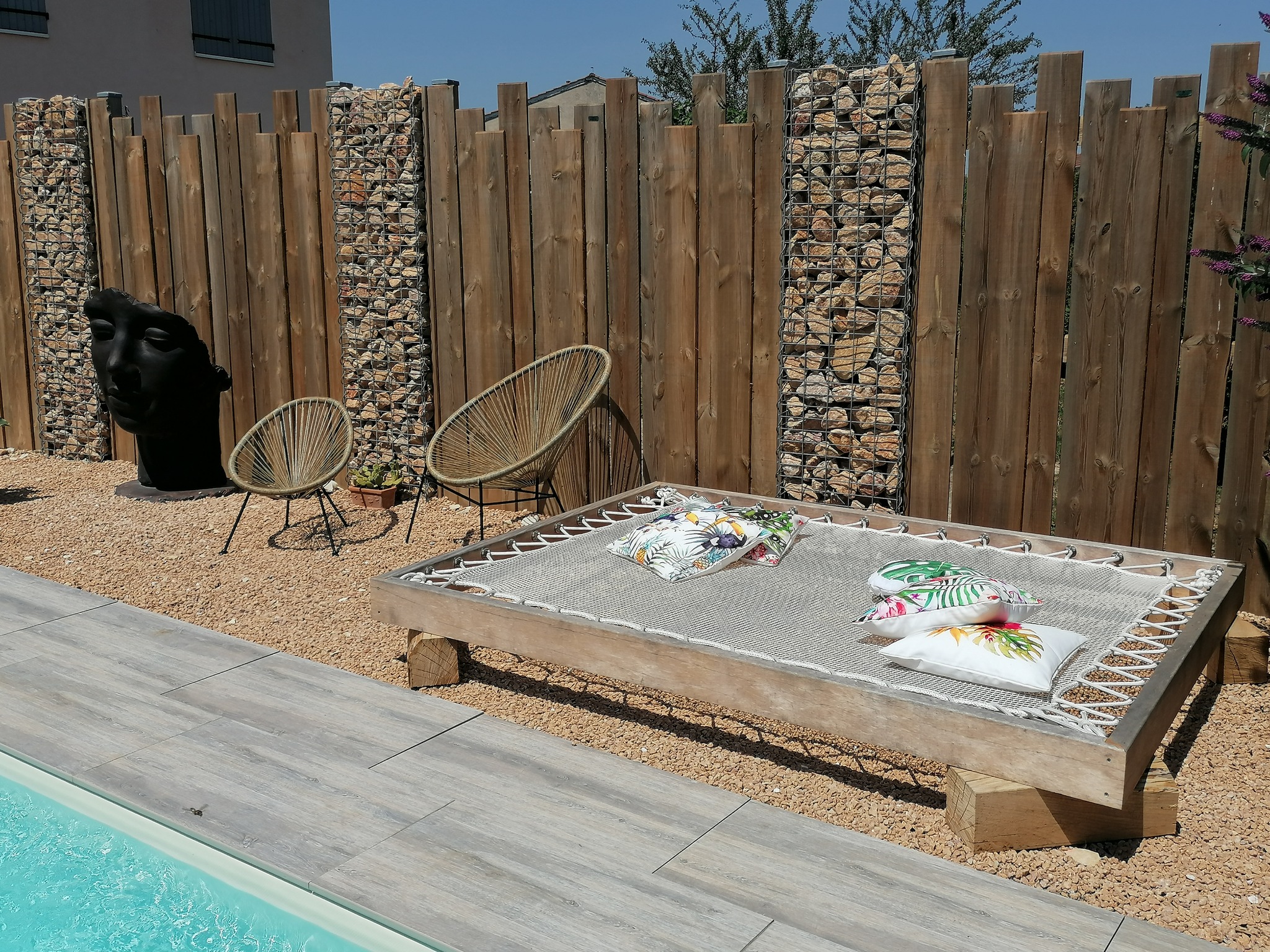
Why a Sunbed Is the Deck Upgrade Your Patio Needs This Summer
The traditional sunbed has been a backyard staple for decades. It does the job — but it's also heavy, awkward to reposition, quick to show wear, and frankly, not all that interesting. As outdoor living continues to evolve into a genuine extension of the home, more people are asking a simple question: is there a better way to lounge outside?
The Case for a Net Over a Sunbed
At first glance, a suspended net and a plastic recliner seem like different categories entirely. But when you consider what you're actually looking for in an outdoor lounging experience — comfort, airflow, a sense of ease — the net starts to make a compelling case for itself.
Air circulation changes everything. A traditional sunbed traps heat between your body and the surface beneath you. A net, by contrast, is open on all sides. Air moves freely around you, which makes the experience dramatically more comfortable on hot summer afternoons — the exact conditions when most people want to be outside.
It holds more than one person. A quality home net, properly installed on a deck or patio, becomes a shared space. Two people can lounge side by side, children can sprawl across it, and it naturally invites the kind of unhurried togetherness that outdoor spaces are made for.
It's a visual statement. Decks and patios benefit enormously from thoughtful design. A net — whether installed horizontally as a floating lounge platform or angled to catch a particular view — brings an architectural quality to an outdoor space that a row of sunbeds simply cannot.
Making It Work on a Deck or Patio
Installation comes down to anchor points: sturdy posts, beams, or a pergola structure that can bear a distributed load. Many deck builds already have what's needed. The net itself can be sized to fit the footprint you're working with, and materials can be chosen to complement the aesthetic of the space — natural tones for a wood deck, something bolder for a modern patio.
Feelnets offers custom-made nets built specifically for this kind of residential use, with options to tailor size, colour, and configuration to your setup.
Ahead of the Season
Summer doesn't wait, and the best outdoor upgrades are the ones that are ready when the first warm weekend arrives. A custom net is a one-time installation that pays off every time someone chooses to spend an afternoon outside rather than in.
It's a small shift in thinking — from furniture you place on a deck to a feature that becomes part of it.