




DIY or Professional Install? What It Really Takes to Fit a Custom Net
Can you install a custom net yourself?
Often, yes. Many Feelnets customers fit their own mezzanine, patio or balustrade nets with ordinary tools and a free afternoon. Others are better served by a professional, because of the height, the structure or simply peace of mind.
The right answer depends on three things: where the net goes, what it will be fixed to, and how it will be used. A net people will lie, play or walk on carries real loads. The anchoring has to be right.
This guide explains what the job actually involves, which projects suit a confident DIYer, and when it is wiser to call in an installer.
What installing a custom net actually involves
A made-to-measure net arrives ready to fit. The work is less about the net and more about the structure around it. A typical installation runs in five stages.
- Assess the support. Identify what each edge will attach to: a beam, a joist, a load-bearing wall, a steel frame or a tensioned cable. Every anchor point has to take the load, not just hold the net in place.
- Mark and drill the anchor points. Spacing must be even and consistent with the net's edge. Fixings must suit the material, whether timber, concrete, masonry or steel.
- Fit the mounting hardware. Eyebolts, hooks, tensioners or a perimeter cable, depending on the system you chose.
- Attach and tension the net. Lace or hook the edge progressively, working around the perimeter so tension stays even. Uneven tension leads to sagging in one area and overload in another.
- Test and adjust. Load the net gradually and re-tension after the first few days of use, as fibres and fixings settle.
For a standard mezzanine opening, a capable DIYer can expect to spend half a day to a full day. Complex shapes, high ceilings or outdoor structures take longer.
When DIY makes sense
DIY is a realistic option when the structure is sound, the anchor points are easy to reach, and you are comfortable drilling into it.
Good candidates for self-installation:
- A mezzanine net over a rectangular opening with solid timber or concrete on all four sides.
- A balustrade net along a staircase or landing, fixed to existing posts and handrails.
- A patio or pergola net on a sturdy wooden or steel frame at a manageable height.
- A replacement net going back onto anchors that already exist and are in good condition.
Feelnets designs its hardware with self-installers in mind. Our hook attachment system fits a standard screwdriver and speeds up fitting considerably. Where a side has no load-bearing wall, the steel cable solution creates an anchor line instead.
If you go the DIY route, read the instructions supplied with your net fully before drilling the first hole.
When to call a professional
Some projects are better handed to an experienced installer. Call one in if any of these apply:
- You are unsure what the walls or beams are made of, or whether they can take the load.
- The net is high up. Anything that requires work at height on a ladder or scaffold carries real risk.
- The opening is irregular, curved or spans more than one level.
- It is a commercial project. Hotels, rentals, schools and public venues often need documented installation for insurance or inspection.
- The net will carry children or several adults at once, and you want certainty about the anchoring.
- The structure is outdoors and exposed to wind, water or salt air, such as a dock, a rooftop or a pool terrace.
- You simply don't have the time or tools. A professional will usually finish in a fraction of the time.
A good rule: if you would hesitate to hang a heavy kitchen cabinet on that surface yourself, don't anchor a living net to it either.
Tools and skills checklist for DIY installation
Before you commit, check you have what the job needs.
Tools
- Drill or impact driver with bits suited to wood, masonry or metal
- Spirit level and tape measure
- Stud or joist finder
- Stable ladder or platform at the right height
- Pencil or marker for anchor points
- Spanners for tensioners and cable clamps, if used
Skills
- Confidence drilling into ceilings, beams or walls
- Ability to identify a load-bearing surface
- Patience to tension a net evenly around its whole perimeter
- A second pair of hands: most nets are far easier to fit with two people
If more than one item on this list gives you pause, a professional installation is likely the better choice.

DIY vs professional: how the costs compare
DIY saves the labour cost, but it is not free. Weigh both options honestly.
Labour: With DIY, you supply the labour, which typically takes half a day to a day. A professional installer quotes for the work, usually as a fixed price for the job.
Tools: Going DIY means buying any tools you don’t already own. A professional brings everything needed.
Structural assessment: When you install it yourself, you rely on your own judgement about whether the structure can take the load. A professional assesses it on site, drawing on experience.
Speed: A first DIY installation is usually slower. A professional typically finishes faster.
Risk if something goes wrong: With DIY, any problem is yours to fix. With a professional, the installer’s workmanship covers it.
Best for: DIY suits simple, accessible, residential projects. A professional is the better choice for work at height, complex shapes and commercial sites.
Finding an installer: the Feelnets craftsmen network
Feelnets works with independent craftsmen who install residential nets. Carpenters, builders and fitters can join as partners, so customers can be put in touch with someone who knows the products.
If you would rather not install the net yourself, mention it when you request your quote. Tell us where the project is, what the net attaches to, and send a few photos of the space. We will let you know whether a partner installer is available in your area.
Are you a tradesperson yourself? Learn how to become a Feelnets installation partner.
Frequently asked questions
Is it hard to install a mezzanine net yourself? Not for a confident DIYer with a solid structure to work with. The trickiest parts are finding sound anchor points and getting the tension even all the way round.
How long does it take to install a custom net? A standard mezzanine or balustrade net usually takes half a day to a day for a first-timer. Large, irregular or outdoor projects take longer.
Can I install a net without a load-bearing wall? Yes. A tensioned steel cable can create an anchor line where no wall or beam exists. It must itself be fixed to solid points at each end.
Do I need a professional for a net children will play on? Not necessarily, but the anchoring must be beyond doubt. If you have any uncertainty about the structure, a professional assessment is worth it.
Does Feelnets supply the mounting hardware? Yes. Hardware is chosen to suit your project and can be ordered with the net. Our mounting hardware guide explains the options.
Can a net be reinstalled after moving house? Often, if the new opening is similar in size and shape. Send us the dimensions and we can advise whether it will fit or needs adapting.
The bottom line
If the structure is solid, the opening is simple and you are handy with a drill, installing your own net is entirely realistic. If the job involves height, uncertain walls, a commercial site or children's safety, bring in a professional.
Either way, it starts with a net made to the exact size of your space. Design your custom net or request a free quote, and tell us whether you plan to install it yourself. We will recommend the right hardware either way.

Where Interior Nets Work — and Where They Don't
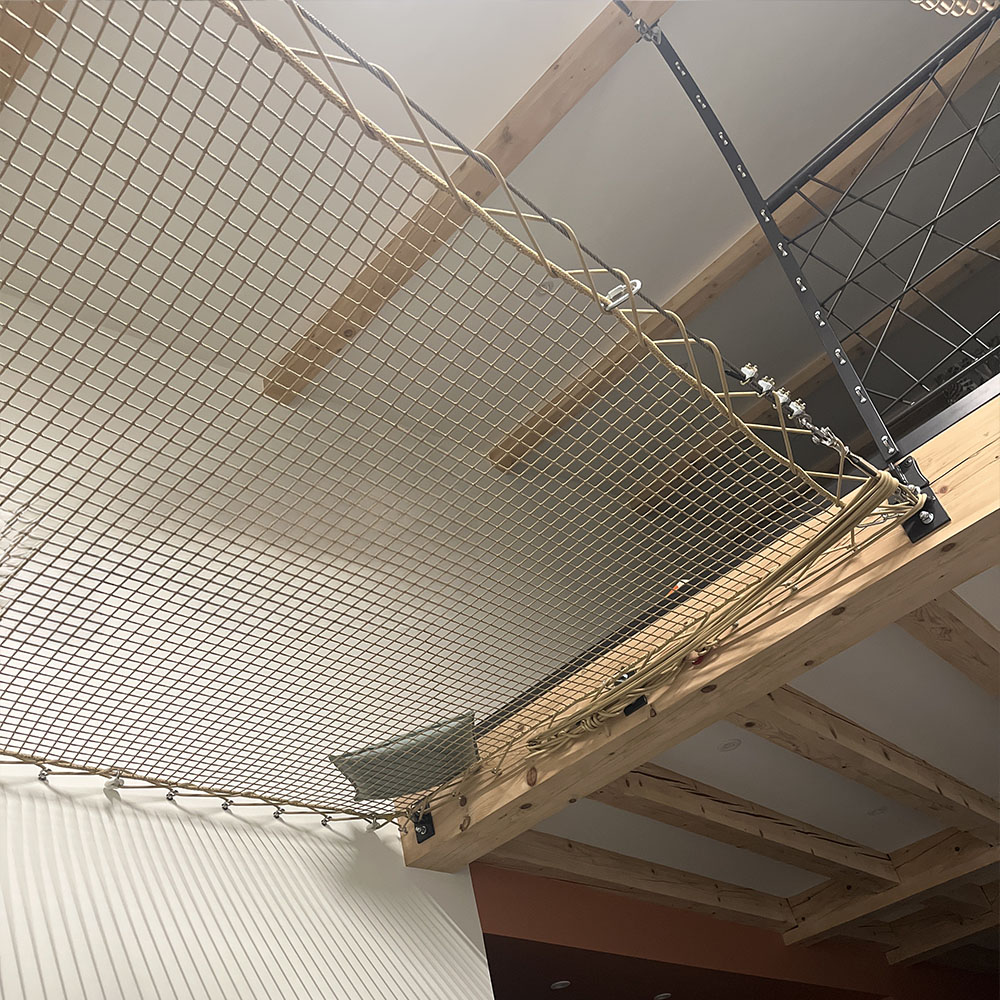
Short answer: an interior net needs four things. Two or more solid anchor lines on opposing sides, a structure able to take sustained horizontal tension, a span your manufacturer can cover in a single piece, and a sensible relationship between the net and what sits below it. Spaces with all four — double-height living rooms, open mezzanines, generous stairwell voids — are straightforward. Spaces missing one are usually still possible with extra structural work. Spaces missing two are normally better served by something else.
Most of the disappointment in this category comes from finding out at quotation stage what could have been established in five minutes. Here is how to work it out yourself first.
The four conditions a space needs
Solid anchor lines on opposing sides. A net is tensioned between fixings, so it needs something substantial to pull against on at least two opposite edges — ideally all four. Structural walls, steel beams, and properly sized timber all qualify. Plasterboard partitions, decorative beams and stud walls do not, on their own.
A structure that can take horizontal load. This is the condition people miss. A tensioned net does not simply hang downward like a hammock slung between two trees — it pulls inward, horizontally, on everything it is fixed to, and it does so permanently. A wall that happily carries vertical load may behave differently when pulled sideways for years. This is the single most common reason a project needs an engineer.
A workable span. Every manufacturer has a practical maximum for a single piece. Larger areas are covered by subdividing with intermediate supports, which is normal and often visually fine — but it changes the design, so it is better known early.
A sensible relationship to what is below. What sits underneath, how far below, and who will use the net all shape the specification. Discuss this with your manufacturer rather than assuming.
Double-height living rooms: the ideal case
If you have an open void above a living area, flanked by structural walls or a mezzanine edge, you have the textbook installation.
These spaces work because the anchor lines are already there and already structural, the span is usually within single-piece range, and the result solves a real problem: double-height rooms look impressive and often feel disconnected, with the upper level cut off from the life of the house. A net bridges that without closing the volume in, because you can still see through it.
This is also where a net most obviously beats the alternative. Building a solid floor costs more, needs structural design, and takes the light and the height away.
Stairwells and landings
Often excellent, occasionally awkward.
Stairwell voids tend to be surrounded by structural walls, which is exactly what you want. The complications are shape and access. Stairwells are frequently irregular — not rectangular, not square, with walls that are not parallel and corners that are not 90°. Made-to-measure manufacturing handles this routinely, but it makes accurate measurement more important, and guesswork more expensive.
The other consideration is what the net does to circulation. A net across a stairwell changes how people move through the house and how objects are carried up and down. Worth thinking through before it is installed rather than after.
Attic and under-roof spaces
Possible, with more constraints than most people expect.
The difficulty is that roof structures slope. A net wants opposing anchor lines at a consistent height, and a pitched roof gives you converging surfaces at varying heights instead. Sometimes there is a purlin or a collar tie at a usable level; sometimes the only fixings available are rafters that were never intended for sustained horizontal tension.
Converted attics with a flat ceiling section and knee walls are considerably easier than raw roof spaces. If you are at the design stage of a conversion, this is a good moment to ask — adding a suitable beam during the build is inexpensive, and retrofitting one later is not.
Small rooms and standard ceiling heights
Usually the wrong application, and it is worth being direct about it.
In a room with a standard ceiling height there is no void to span. A net installed low in an ordinary room cuts the space in half and makes both halves less usable. The product works because it occupies volume nobody was using; where there is no spare volume, it takes away rather than adds.
The exception is a small footprint with real height — tiny houses, narrow city apartments with tall ceilings, converted industrial spaces. There, a net can genuinely add floor area without a structural build. The test is height available above head height, not floor area.
 Terraces, balconies and outdoor spaces
 Terraces, balconies and outdoor spaces
These work well, with different priorities.
Outdoors, material specification matters more. Sun, rain, frost and — near the coast — salt all act on the mesh continuously. Marine-grade polyester is designed for exactly this; cheaper fibres degrade, and the failure is gradual enough that people often do not notice until the net has lost a lot of its original condition.
Balcony and terrace installations also tend to sit above a drop, which raises the same questions as any barrier at height. Local requirements vary by country, so check what applies where you are before ordering.
Where a net is the wrong answer
Honest answers are worth more than optimistic ones, so:
When you need a load-bearing floor. If you want to put furniture on it, store things on it, or treat it as a room, you want a floor. A net is a surface for people, not for permanent load.
When acoustic or visual separation is the point. A net transmits sound and sight completely. If the goal is a quiet room or a private one, it works directly against you.
When there is nothing structural to fix to. If every surrounding surface is partition wall and the ceiling is suspended, the honest answer is that the building needs work first.
When it is a rental and fixings are not permitted. Installation means permanent anchors in structural elements. There is no genuinely temporary version.
When the void is small. Below a certain size, a net reads as an obstruction rather than a feature, and the cost per usable square metre stops making sense.
What makes a project straightforward — or expensive
Straightforward: a rectangular opening, structural walls on all sides, standard fixings into concrete or masonry, a span within single-piece range, and clear access for installation.
Expensive: irregular geometry with several non-parallel edges, fixings into unsuitable material requiring new structure, spans needing subdivision, difficult access, or a requirement discovered after the surrounding finishes are complete.
The pattern is consistent — cost is driven by the building, not by the net. Two nets of identical size can differ substantially in total project cost because one had four solid walls waiting and the other needed a steel beam first.
Frequently asked questions
Can you put a net over a stairwell? Usually yes — stairwell voids are often surrounded by structural walls. Irregular shapes are normal and handled by made-to-measure manufacturing; accurate measurement matters more than in a simple rectangle.
Do I need a structural engineer? Not always. You are more likely to need one if fixings go into timber rather than masonry, if the span is large, if the structure is old or unknown, or if you are altering the building to create anchor points.
Can a net be installed in a rented property? Rarely, in practice. Installation requires permanent fixings into structural elements, which normally needs the owner's consent.
What is the minimum space needed? Less about floor area than height. You need a genuine void — somewhere nobody currently uses — and solid opposing edges to anchor to.
Can a net be removed later? The net itself can be taken down and refitted. The anchor points stay in the structure, though they can be made discreet.
Can it be fitted to a sloping roof? Sometimes, if there is a purlin, collar tie or beam at a usable height. Raw rafters are often unsuitable. Easier to plan during a conversion than to retrofit.
Feelnets has manufactured made-to-measure nets in Quimperlé, France since 2012, for homes, hotels and multihulls worldwide. Send us your dimensions and a photo of the space and we will tell you whether a net is the right answer.

5 Ways Boutique Hotels Are Using Suspended Nets to Create Instagram-Worthy Spaces
5 Ways Boutique Hotels Are Using Suspended Nets to Create Instagram-Worthy Spaces
In the world of boutique hospitality, a single photogenic corner can do more for bookings than an entire marketing budget. Guests today choose hotels based on what they see on Instagram and Pinterest long before they check the amenities list — and increasingly, what they're looking for is something they've never seen before.
That's exactly why suspended nets have become a signature feature for hotels around the world, from private villas in the Maldives to design-forward properties in Europe. A custom-made net isn't just a place to relax — it's a design statement that photographs beautifully, feels genuinely unique, and gives guests a reason to share their stay online.
Here are five ways boutique hotels are using suspended nets to create spaces guests can't stop photographing.
1. Overwater and Poolside Sunbed Nets
Nothing captures the fantasy of a tropical escape quite like a net suspended above turquoise water. Overwater sunbed nets, like those installed in luxury bungalows in the Maldives, let guests lie suspended just above the lagoon, creating a striking visual effect that's become one of the most recognizable images in luxury travel marketing.
Poolside versions offer the same effect closer to home: nets stretched over or beside a pool deck create a floating, weightless look that stands out immediately in a sea of standard sun loungers.
2. Elevated Terrace Lounging
Suspended terrace nets, positioned at height above a garden, courtyard, or view, give guests a genuinely new way to experience a space they'd otherwise just walk past. Properties are increasingly integrating nets directly into pergolas and terrace structures, turning an ordinary outdoor seating area into a architectural focal point that anchors the whole space.
The vantage point alone — lying suspended above the ground, looking out over a view — is often enough to generate spontaneous guest photos and social shares, at no extra marketing cost to the hotel.
3. Statement Lobby and Reception Features
First impressions matter, and increasingly hotels are bringing net installations indoors as architectural statement pieces in lobbies and reception areas. A well-placed suspended net softens a space, adds texture and warmth, and immediately signals to arriving guests that this property has design ambition beyond the standard hotel template.
Unlike static decor, a suspended net changes how the space feels depending on lighting and time of day — an important detail for hotels that want their interiors to photograph well from multiple angles.
4. Rooftop and Sky-Level Relaxation Areas
Rooftop bars and lounges are prime real estate for hotel branding, and suspended nets are increasingly part of that strategy. Positioned at height with a skyline or ocean view behind them, net installations turn a rooftop into a destination in its own right — the kind of space guests seek out specifically to photograph at sunset.
For hotels competing in dense urban markets, a rooftop net feature can become a genuine point of differentiation in a category where most properties look remarkably similar.
5. Private Villa and Suite Exclusives
For hotels offering premium villas or suites, a custom net installation — whether a private terrace net, an indoor mezzanine feature, or a suspended reading nook — adds a layer of exclusivity that justifies premium pricing. These private, made-to-measure features signal that the space was designed specifically for that room, not replicated across the property.
This kind of bespoke detail is precisely what encourages guests to share their experience, tag the hotel, and drive organic visibility that no paid campaign can fully replicate.
Why Hotels Choose Custom-Made Nets Over Off-the-Shelf Solutions

Every one of these applications depends on getting the details right: mesh density, UV and weather resistance, load capacity, and a finish that matches the property's design language. A generic, mass-produced net rarely achieves the seamless, architectural look that boutique hotels are after — which is why nearly 200 hotels worldwide have turned to made-to-measure netting instead.
At Feelnets, every net is designed and manufactured in France to the exact dimensions, mesh size, and color of each project, ensuring the final installation looks intentional rather than added on. From overwater bungalows to rooftop lounges, our team works with hotels from initial concept through to installation, delivering a feature guests will want to photograph — and share.
Ready to design a signature net feature for your property? Get your personalized quote in under 3 hours and discover how Feelnets can bring your hotel's next standout space to life.

How a Custom Home Net Can Elevate Your Canadian Cottage Experience
There's something timeless about a Canadian cottage. The smell of pine in the morning, a dock stretching out over still water, the rhythm of a slower life. But as cottage ownership evolves — with more families using their properties year-round, renting them out, or simply investing more intentionally in the experience — the question of how to meaningfully improve a cottage has become increasingly relevant.
Most people think of renovations: a new deck, updated kitchen, fresh landscaping. These are all valid upgrades. But one of the most overlooked — and most versatile — DIY improvements is the addition of a custom home net.

What Is a Home Net, Exactly?
A home net (also called a hammock net, lounge net, or suspended net) is a large woven net installed between structural points — beams, trees, pergola posts, or a dedicated frame — creating a suspended lounging surface that people can lie, sit, or play on. Unlike traditional hammocks, they're wide enough for multiple people, open to the air on all sides, and designed to blend into their environment.
Feelnets, a company specializing in custom-made nets for residential use, offers handcrafted options that can be tailored in size, shape, colour, and material to suit almost any cottage setup.
Why It's One of the Best Cottage DIY Projects
1. It Adds Usable Square Footage — Outdoors
Cottage square footage is precious. A net installed above a deck, between trees, or inside a sunroom creates an entirely new functional zone without a single wall being built. Children claim it as a play space. Adults use it for afternoon naps or stargazing. It becomes the spot where people gravitate naturally.
2. It's Genuinely DIY-Friendly
Unlike major renovations that require permits, tradespeople, and months of planning, a home net can typically be installed by a couple of people in a day. The main requirements are solid anchor points and basic hardware. For cottagers who enjoy hands-on projects, this is a satisfying weekend build with an immediate payoff.
3. It Elevates the Rental Value of a Property
For cottage owners on platforms like Airbnb or VRBO, standout features matter. A suspended net photographed at golden hour — strung between birch trees or overlooking a lake — is the kind of image that books weekends. It signals that a property has been thoughtfully designed, not just adequately furnished.
4. It Suits the Canadian Outdoors Beautifully
Canada's cottage country is defined by its natural environment: rocky shorelines, dense forests, long summer evenings. A net installation can be positioned to take advantage of exactly that — suspended over a hillside, nestled in a tree canopy, or placed to frame a particular view. The design adapts to the landscape rather than imposing on it.
5. It's Built to Last in Variable Conditions
Quality nets designed for outdoor use are made to handle UV exposure, moisture, and the temperature swings that Canadian seasons bring. With proper installation and seasonal care, they're a long-term addition — not a novelty that deteriorates after a summer.
A Simple Upgrade With Real Impact
Not every cottage improvement needs to be a large-scale project. Sometimes the right addition is one that changes how people actually spend their time at the property — how they relax, where they gather, what they look forward to. Improvement Cottage Canada.
A custom home net does exactly that. It's practical, visually striking, and deeply suited to the unhurried pace that cottage life is supposed to offer.
If you're looking for a starting point, Feelnets offers custom options with guidance on sizing and installation — a useful resource whether you're planning a specific setup or just getting a sense of what's possible.
Improvement Cottage Canada
Contact us to receive a custom quote

Relax in Style with a Net Bed


Looking to elevate your indoor or outdoor space? A net bed is the perfect blend of comfort, style, and versatility. We specialize in high-quality net beds designed for ultimate relaxation—whether you're lounging on your patio, inside a cozy reading nook, or suspended above your living room floor.
Our custom net beds are made from durable, weather-resistant materials that support your body while giving you that floating, weightless feeling. Easy to install and visually striking, net beds are a favorite for modern homes, tiny houses, and creative interior designs. They're also popular for playrooms and lofted areas where space and safety matter.
At Feelnets, we offer a wide range of net bed solutions that can be tailored to your space. Whether you're after a hammock-style net, a floor net bed, or a suspended lounging area, we can help bring your vision to life.
Transform any corner into a relaxation zone with a custom net bed from Feelnets —where comfort meets creativity.
Shop now and discover why more homeowners and designers are choosing net beds as the ultimate space-saving comfort solution.
Contact us now to receive a custom quote

Custom Guardrail Nets: Safety Meets Style for Homes and Commercial Spaces.
Custom Guardrail Nets
In both homes and commercial spaces, safety often competes with aesthetics—yet Feelnets bridges this gap with custom guardrail nets that secure without compromising design. These nets serve as effective fall protection for elevated zones like balconies, terraces, staircases, and mezzanines—especially useful in households with kids, seniors, or pets, where traditional railings may feel bulky or obstructive.
Feelnets’ bespoke approach means each net is tailored to your space, fitting snugly into frames or overlaying existing rail structures with clean lines. Want minimal visual intrusion? Their knotless nets in a choice of meshes—such as airy 48×48 mm for transparency, or dense 13×13 mm for extra security—ensure both safety and lightness. Available in versatile colours (beige, black, white, grey), the nets complement modern decors while retaining functionality.

Beyond residential charm, these systems shine in commercial settings—think boutique hotels with suspended nets over terraces or lagoon-facing lounging areas that double as inviting décor and guardrail reinforcement. Feelnets even provides full-service solutions—from material selection (durable UV-/weather-resistant polyester, PVC Mesh, etc.) to high-quality fixings (eye bolts, tension ropes)—ensuring a secure, polished final product.
Moreover, their industrial-grade nets carry a load resistance of over 200 kg/m², demonstrating trustworthiness even in demanding environments. Personalized quotes arrive within hours, with manufacturing in France and delivery worldwide—making safety easy, beautiful, and global.
Using Feelnets’ custom guardrail nets lets you secure your spaces with understated elegance—whether at home or in a commercial display—without sacrificing either safety or style.

Elevate Your Custom Home Renovation with Feelnets’ Architectural Nets
When planning a custom home renovation, homeowners are increasingly looking for ways to add functionality, style, and a sense of uniqueness to their spaces. Today’s custom builds and renovations are about more than high-end finishes—they’re about creating an environment that reflects personal taste while offering clever, modern solutions to maximize every inch of space. That’s exactly we, as Feelnets, a leader in custom architectural nets, brings to the table.
With roots in innovation and design, Feelnets offers tailor-made net systems for both indoor and outdoor spaces. Our custom solutions include mezzanine floor nets, guardrail safety nets, loft bed hammocks, and deck and dockside lounging nets, all engineered for safety, comfort, and aesthetics. Whether you're updating a family home, renovating a rental property, or reimagining a cottage retreat, we help you transform space into experience.

Transform Vertical Space with Mezzanine Floor Nets
In many homes and cottages, high ceilings create impressive volume but often leave usable space untouched. Feelnets' mezzanine floor nets are the perfect way to take advantage of vertical areas during your renovation. Suspended like a floating hammock, these nets can turn an empty upper level or loft void into a playful and functional lounging area. Ideal for reading, relaxing, or even as a quiet nap zone, mezzanine nets add a distinctive architectural feature while making use of otherwise wasted space.
These nets are especially popular in open-concept homes, modern lofts, and A-frame cottages where ceiling height is abundant. Each net is fully custom-designed to suit your dimensions, desired tension, and aesthetic vision—ensuring it blends perfectly with the rest of your renovation.
Guardrail Nets: Safe, Minimalist, and Stylish
Safety features often feel like an afterthought in home design, but we proves they can be beautiful and functional. Our guardrail safety nets are a smart alternative to traditional railings for staircases, mezzanines, or balconies. Made from high-strength materials, these nets maintain the openness of your space while adding a secure barrier that’s ideal for families with kids or pets.
Guardrail nets are popular in multi-level custom homes and vacation cottages, especially where clean lines and unobstructed views are a design priority. Instead of blocking light with heavy barriers, Feelnets' safety nets provide protection while keeping the architectural flow seamless and modern.
Maximize Small Spaces with Loft Bed Nets
Space-saving solutions are a must in small home renovations, tiny cabins, or city apartments. A loft bed net from Feelnets is a clever way to create sleeping or lounging areas without taking up valuable floor space. These suspended nets function as flexible platforms that can be used as a bed, reading nook, or playful hangout spot for kids.
Perfect for custom homes that prioritize minimalism or multifunctional design, loft bed nets are fully customizable and engineered for safety. They’re also a standout feature in Airbnb properties or vacation rentals, adding visual interest and Instagram-worthy appeal.
Create an Outdoor Experience with Deck and Dock Nets
Outdoor renovations are just as important as what’s inside, especially in cottage country or waterfront homes. Feelnets offers outdoor net installations that redefine how you interact with nature. Their deck and dockside nets allow you to lounge above water, forest, or garden—blending effortlessly into natural surroundings while providing a luxurious spot to unwind.
In addition, these nets are weather-resistant, UV-protected, and built to endure the outdoor elements of Canadian and American climates. For cottage renovations, they offer a unique experience that guests and family members won’t forget—perfect for lakeside reading, sunbathing, or stargazing.
Custom Design, Unmatched Craftsmanship
What sets Feelnets apart in the world of custom home renovation is their commitment to fully bespoke solutions. Every net is handcrafted to fit your space, your needs, and your style. From material selection and color to mesh size and integration method, every detail is thoughtfully tailored to your project.
Feelnets collaborates closely with homeowners, architects, and interior designers across the U.S. and Canada to deliver stunning, durable installations. Whether your renovation is modern, rustic, industrial, or boho-inspired, their net systems can be seamlessly integrated into your design concept.
Rethink What’s Possible in Custom Renovation
As custom home renovation continues to evolve, homeowners are seeking more than just visual upgrades—they want purposeful, interactive design elements that enhance daily living. Feelnets answers that call with innovative, space-saving, and visually striking net systems for homes and cottages alike.
In conclusion, from mezzanine floor nets that make use of high ceilings, to guardrail nets that protect without obstructing, to outdoor lounge nets that bring you closer to nature — we offers a unique take on what a modern renovation can be.
Ready to transform your space? Contact us to explore custom options and get inspired for your next project.

Premium Nautical Polyester Net: Comfort, Durability, and Performance
Premium Nautical Polyester Net
Our Nautic polyester net, featuring a black 13x13mm mesh with anti-UV treatment, is designed to withstand the harshest marine conditions. This net is not only highly resistant but also offers superior comfort, making it an excellent choice for lounging and enjoying your sailing adventures.
Catamaran Trampoline Nets by Feelnets
When it comes to catamaran trampoline nets, Feelnets stands as a trusted specialist, providing high-quality, durable, and comfortable solutions for all multihull models. Whether you're looking to replace an existing trampoline or upgrade to a more resilient option, Feelnets offers an extensive selection tailored to your needs.
Wide Selection for All Major Catamaran Brands
Feelnets provides trampoline nets for top catamaran brands, including Fountaine Pajot, Lagoon, Nautitech, Sunreef, Excess, and Catana. Whether you own a brand-new vessel or need a second-hand replacement, our expert team ensures a perfect fit for your multihull.
A Range of High-Quality Materials
We offer various mesh types to meet different preferences and needs:
- Polyester Mesh: Available in 30x30mm (white, black, or grey) and 13x13mm (white or black).
- Dyneema Net: A 22x22mm grey coated mesh that is pre-tensioned with no relaxation rate, ensuring a perfectly adjusted fit.
- PVC Mesh: Available in 492 or 392 with welded and sewn edges, featuring eyelets around the perimeter or sleeves for rope attachment.
Trusted by the World's Leading Boat Rental Companies
Feelnets is a proud partner and supplier to the world’s most renowned boat rental companies, providing top-tier trampoline nets for their fleets.
Global Delivery with Expert Support
No matter where your catamaran is docked, Feelnets ensures worldwide delivery with a team of professionals ready to assist in selecting the best trampoline net for your vessel.
Upgrade your catamaran's comfort and durability with Feelnets—your expert in trampoline nets for multihulls. Contact us today to find the perfect net for your adventure on the water.
Contact us Now

Using Custom Nets as Windbreakers for Horse Stables

Horse stables are often exposed to strong winds, which can create discomfort for horses and increase the risk of respiratory issues. A practical solution to this problem is the use of custom net windbreakers, designed to reduce wind impact while maintaining proper ventilation.
At FeelNets, high-quality custom nets can be tailored to fit stable openings, providing a protective barrier that minimizes wind while allowing fresh air circulation. These nets also help reduce dust and debris, creating a healthier environment for horses.
Using windbreak nets in horse stables offers several advantages:
- Wind Protection – Reduces harsh winds while allowing airflow.
- Better Air Quality – Minimizes dust and airborne particles.
- Durability – Made from high-strength materials, built to last in outdoor conditions.
- Customization – Designed to fit different stable sizes and openings.
By choosing FeelNets for stable windbreak solutions, horse owners can ensure a comfortable, well-ventilated environment for their animals while maintaining a sturdy, long-lasting solution against the elements.


Trampoline for Cruising Catamarans: The Ultimate Guide for Your Sailing Adventure

When it comes to outfitting your cruising catamaran, every detail matters to ensure safety, comfort, and fun on the open water. One essential component for any catamaran is a high-quality trampoline. A trampoline for cruising catamarans serves multiple purposes, from providing a comfortable lounging space to improving the boat’s overall stability. In this guide, we’ll explore why a trampoline is a must-have feature for your catamaran and how to choose the best one for your vessel.
Why Choose a Trampoline for Your Cruising Catamaran?
Cruising catamarans are known for their twin hulls, which offer excellent stability and a smooth sailing experience. However, this unique design also opens up ample space between the two hulls, and this space is where the trampoline comes into play.
A trampoline creates a perfect area for relaxing on deck. Whether you’re sunbathing, taking in the views, or enjoying a quiet moment, the trampoline gives you a soft and comfortable surface to rest on. It’s a great spot for guests or crew to relax while cruising.
Space is often a luxury on a cruising catamaran, and the trampoline provides an efficient use of the space between the hulls. Not only does it add comfort, but it also enhances the boat’s functionality by offering a convenient, multi-purpose area. You can store gear, engage in water activities, or simply enjoy the breeze.
The trampoline also enhances your boat’s overall stability. In the event of rough waters, it can act as an additional shock absorber, ensuring that you and your guests have a smoother ride. The trampoline’s secure fit and material can also help reduce the risk of slipping or falling overboard.
Unlike traditional solid surfaces, a trampoline allows for excellent ventilation and airflow, which is especially valuable on warm, sunny days. This ensures that your deck area remains cool and comfortable, even in hot climates.
How to Choose the Best Trampoline for Your Cruising Catamaran
Selecting the right trampoline for your catamaran is crucial for performance, comfort, and durability. When making your purchase, the material quality is one of the most important aspects to consider. High-quality fabrics such as UV-resistant polyester or mesh are ideal, as they can withstand harsh sun exposure, saltwater, and wind. This will ensure your trampoline lasts for years without compromising on comfort or durability.
Make sure the trampoline is the correct size for your specific catamaran model. A properly fitted trampoline will enhance both safety and aesthetics, and it won’t interfere with your sailing activities. Many suppliers, like FeelNets, offer customizable options to fit various catamaran models.
Check the weight capacity of the trampoline to ensure it can handle the load you require. A trampoline that can accommodate a larger weight capacity will be safer and more practical for entertaining guests or heavy-duty use while cruising.
Ease of installation is another important factor. You’ll want a trampoline that is easy to install and maintain. Look for trampolines with simple attachment systems that allow for quick setup and removal. This will save you time when preparing your boat for a trip.
Lastly, choose a trampoline that complements the look of your cruising catamaran. With various colors and designs available, you can select one that matches your boat’s overall aesthetic, giving it a sleek, stylish appearance.

Why FeelNets Is Your Go-To Source for Trampolines for Cruising Catamarans
At FeelNets, we understand that every cruising catamaran owner needs the best quality materials and exceptional craftsmanship. Our trampolines are designed with comfort, durability, and functionality in mind. With our customizable options, you’ll find the perfect fit for your catamaran, ensuring you can enjoy a smooth, safe, and relaxing cruising experience.
Whether you're cruising pristine waters or sailing across the open ocean, our trampolines will provide the perfect balance of luxury and practicality for your boat.
A trampoline for cruising catamarans isn’t just an accessory; it’s an essential feature that enhances your vessel’s functionality, comfort, and safety. Choosing the right trampoline for your catamaran will ensure you make the most of your time on the water.